
Top 8 Synup Alternatives
 By Axel
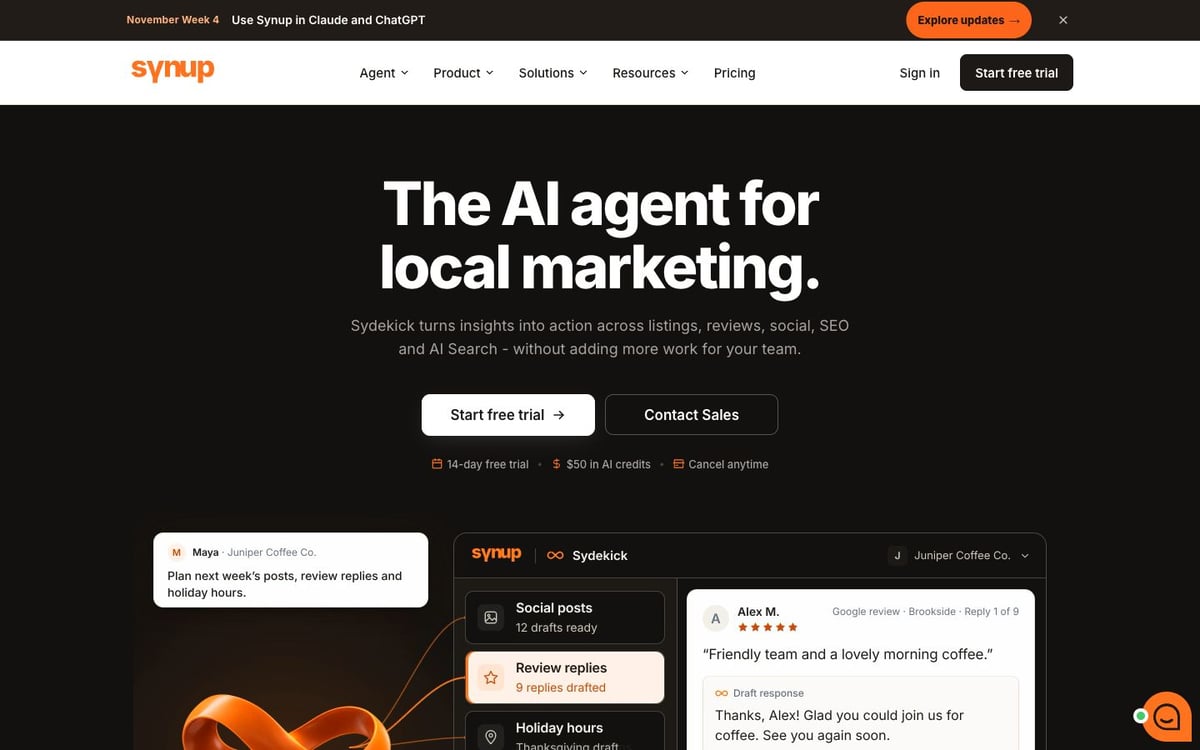
I'm Axel, I founded Reviewflowz, which competes with Synup on one of the things it sells: reviews. Reviewflowz doesn't do listings, social posts or local SEO, and never will, so for most of Synup's suite I'm not your alternative.
To their credit, Synup packs a lot into one plan. It has sold local marketing software from New York since 2013: listings, review monitoring and requests, social posts, SEO, local pages and AEO, with an AI assistant, Sydekick, working across all of it. Every plan gets every feature, and users are unlimited.
You buy it online for up to 50 locations. One location costs $49 a month, and up to ten cost $299 a month. There's a public API too, and an MCP server through which Claude or ChatGPT can read reviews, post replies and send review invites.
So who should stay? Agencies first. Synup is built for them, with a client portal, a command center for many clients and white label from Premium up. If you resell listings and reviews under your own brand, stay, or compare it with Vendasta, GatherUp's white-label plans and BrightLocal's white-label reports. This list isn't written for you.
Nor is it for a business that values one banded price for listings, social, SEO and reviews over depth on the review side.
It's for a business or franchise running 10 to 50 of its own locations in Synup, where the reviews have become the bigger job and the people at each location are the ones earning them. Synup can keep the listings and social posts while the reviews move.
What makes a great Synup alternative
All four points come from Synup's own website and knowledge base.
- Credit for people, not just locations. Synup's leaderboard lines up your locations by rating, reviews, sentiment and response, and its HubSpot and Salesforce connection sends review requests. A great alternative works out which person each review belongs to, from the name in the text, their personal link or the CRM record, then ranks the people.
- Routine replies that post without a click. Synup's AI fills the reply box and stops until someone presses Send, by default its assistant asks before anything goes out, and a bulk reply only saves drafts. A great alternative publishes the routine replies under rules you set and keeps the tricky ones for a person.
- A reply for every review, with no credits to buy. Synup's AI drafts replies on Google and Facebook only, not on Yelp or Tripadvisor, and each draft spends plan credits. When they run out, its agent work pauses until you buy another block. A great alternative writes a reply for every review and doesn't meter them.
- Each manager answering from the alert. Synup posts its Slack notifications to one shared channel for the whole account, and approvals still wait in its Inbox. A great alternative routes every location's reviews to the manager who runs it, by email, Slack or Teams, and that manager answers from the alert itself.
The 8 best Synup alternatives at a glance
| Tool | Best for | Starting price | Contract | Standout |
|---|---|---|---|---|
| Reviewflowz | Location groups handling a heavy review load, with an AI reply on each review | From $45 a month for a single location, billed yearly | Monthly or yearly; cancel or downgrade in the app any day | Every review traced to the staff member behind it, on Premium |
| GatherUp | Local businesses after a reviews-only tool with SMS and email in the price | $99 a location a month on the annual plan | $124 paying month to month; the annual rate means a full year | Automatic AI replies to happy Google and Facebook reviewers |
| Birdeye | Groups of roughly 10 to 250 locations buying one platform from a sales rep | Quote; a third-party site reports $299 a location a month | Renewal unless you write 90 days ahead; 8% added each time | Employees tagged from reviews and ranked on a leaderboard |
| Pluspoint | Chains that want listings, reviews, social and messaging at one price per location | $29 a location a month, from 3 locations | Monthly or yearly, cancel in its billing portal | AI review replies that use no credits |
| BrightLocal | Up to 100 locations, with local search as the main job | $49 a month for one location on an annual plan | Monthly; cancel from your account | Rank tracking, citations and listings next to the reviews |
| ReviewTrackers | Brands that want every location's reviews searchable from one dashboard | $89 a location a month on annual billing | Order form term; rolls over without 30 days' notice in writing | AI replies posted by star rating on Trustpilot and Booking.com too |
| Chatmeter | Brands with 15 to 900+ locations buying reviews, listings and local pages together | Quote | Three-year order forms by default; 60 days' notice to leave | Unattended AI replies in the voice of your earlier ones |
| Uberall | Chains of 25+ locations where listings come first | Quote | Yearly by default; notice due 3 months before the end | A store locator and local pages built around the listings |
The 8 best Synup alternatives
#1 Reviewflowz
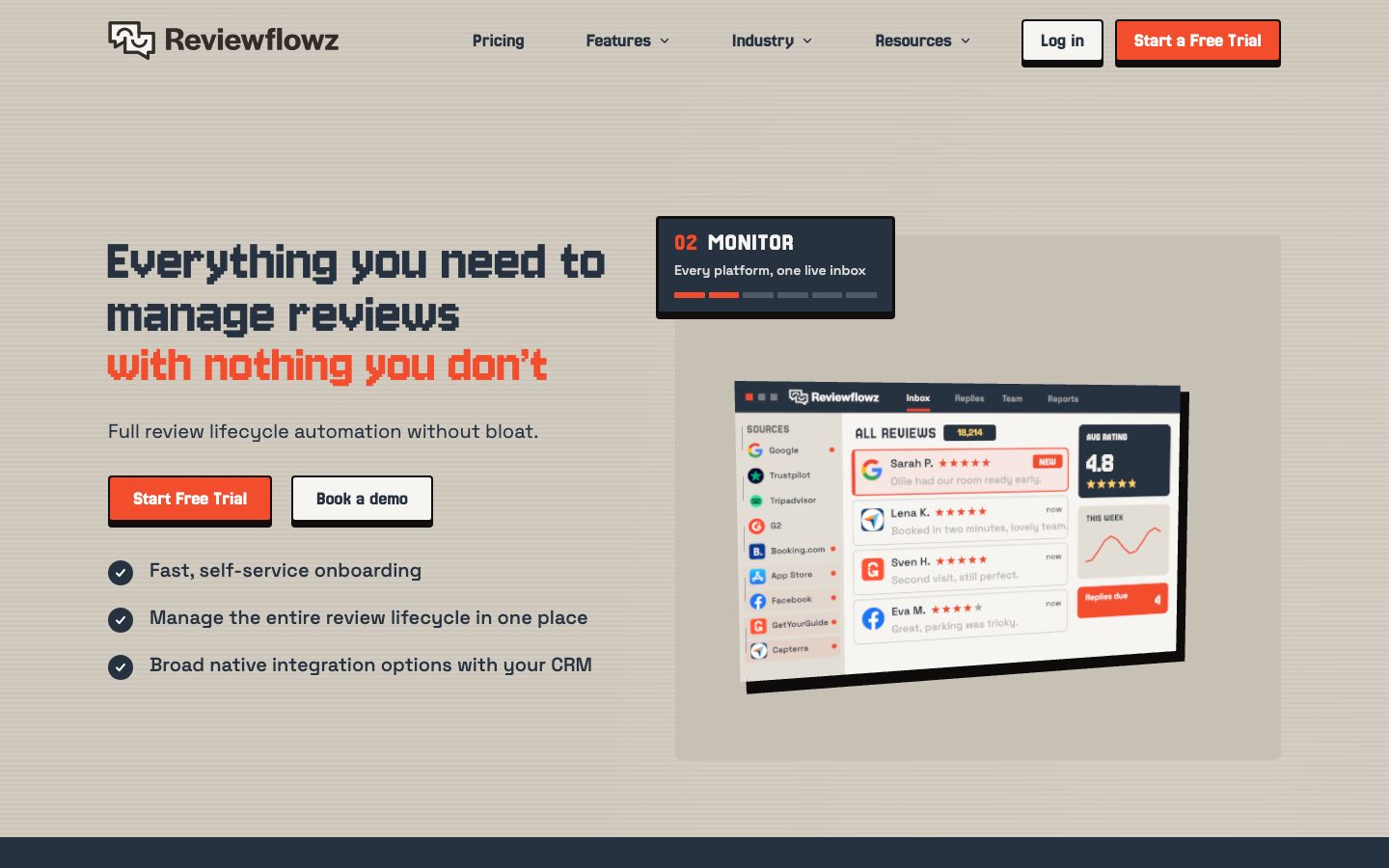
You'd expect me to put my own product first, so weigh this entry with that in mind. But if the reviews at your Synup locations are earned by the people who work there, I think Reviewflowz is the better tool for that job.
Reviewflowz or Synup?
Synup's leaderboard ranks locations, and its HubSpot and Salesforce connection sends review requests. On Premium, Reviewflowz finds the person behind each review, down to whoever owns that customer in your CRM. It also posts the routine replies under your rules, and each manager answers straight from the alert.
Reviews are the only thing it does. It requests them, tracks them on every site, works out which employee earned each one, and writes the reply with AI.
The employee gets the credit. On Premium, Reviewflowz scans each new review for your staff's names, even when the customer writes initials, a nickname or a misspelling, whatever the language or the site.
When a review names nobody, the person on the record gets the credit: the owner of that customer in HubSpot or Salesforce, or the employee on the booking or sale.
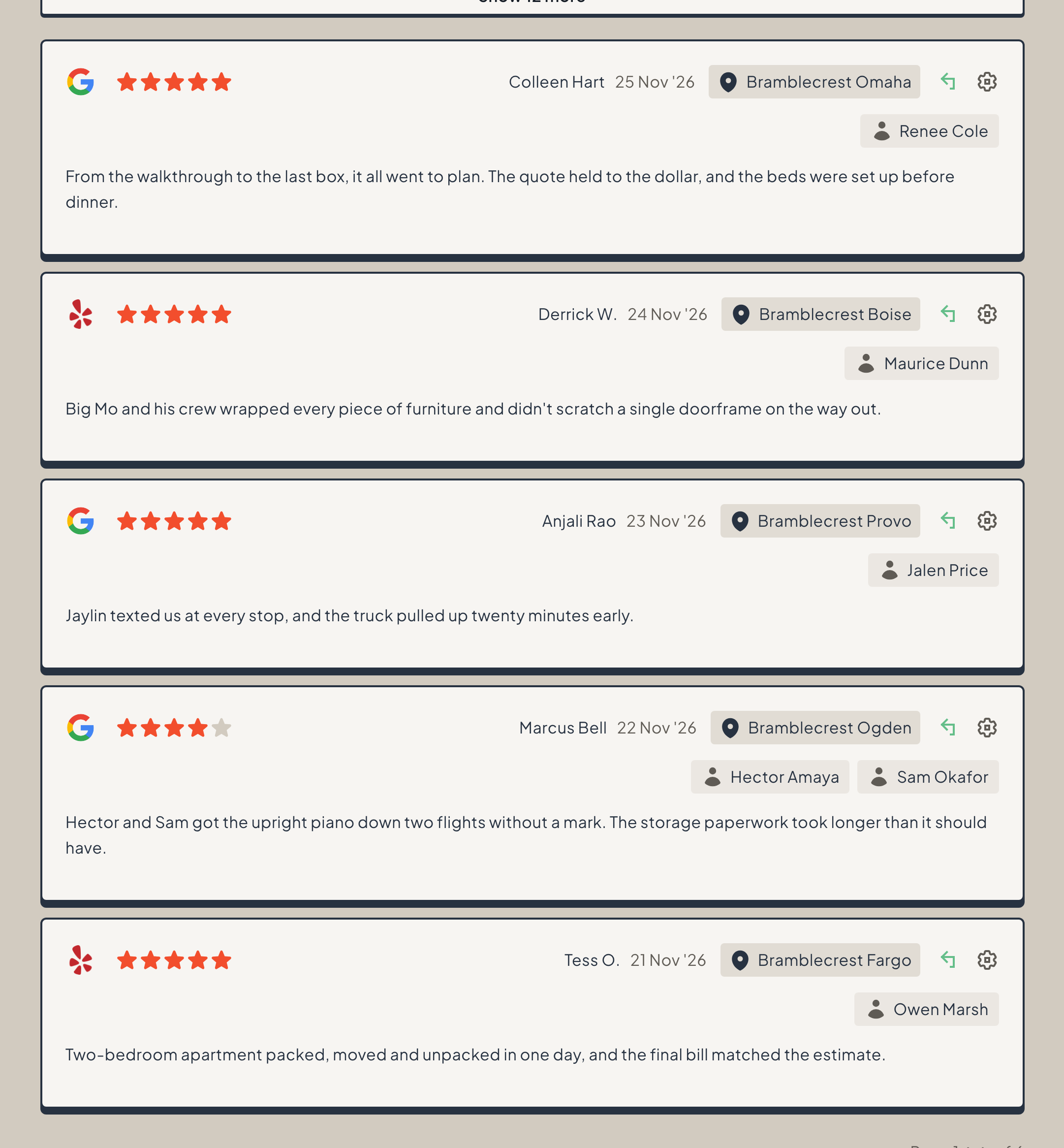
Each employee can also hand out a personal review link or QR code from the companion app, and every review it brings in is credited to them. The three methods work together, and a leaderboard ranks your people across all your locations. See review attribution.
Routine replies go out on their own. Each reply is written from the ones your team has already published, and any location with its own tone gets its own agent. You set rules on star rating, site, location or keyword, and they settle which replies go live on Google and Facebook unattended and which a person checks first.
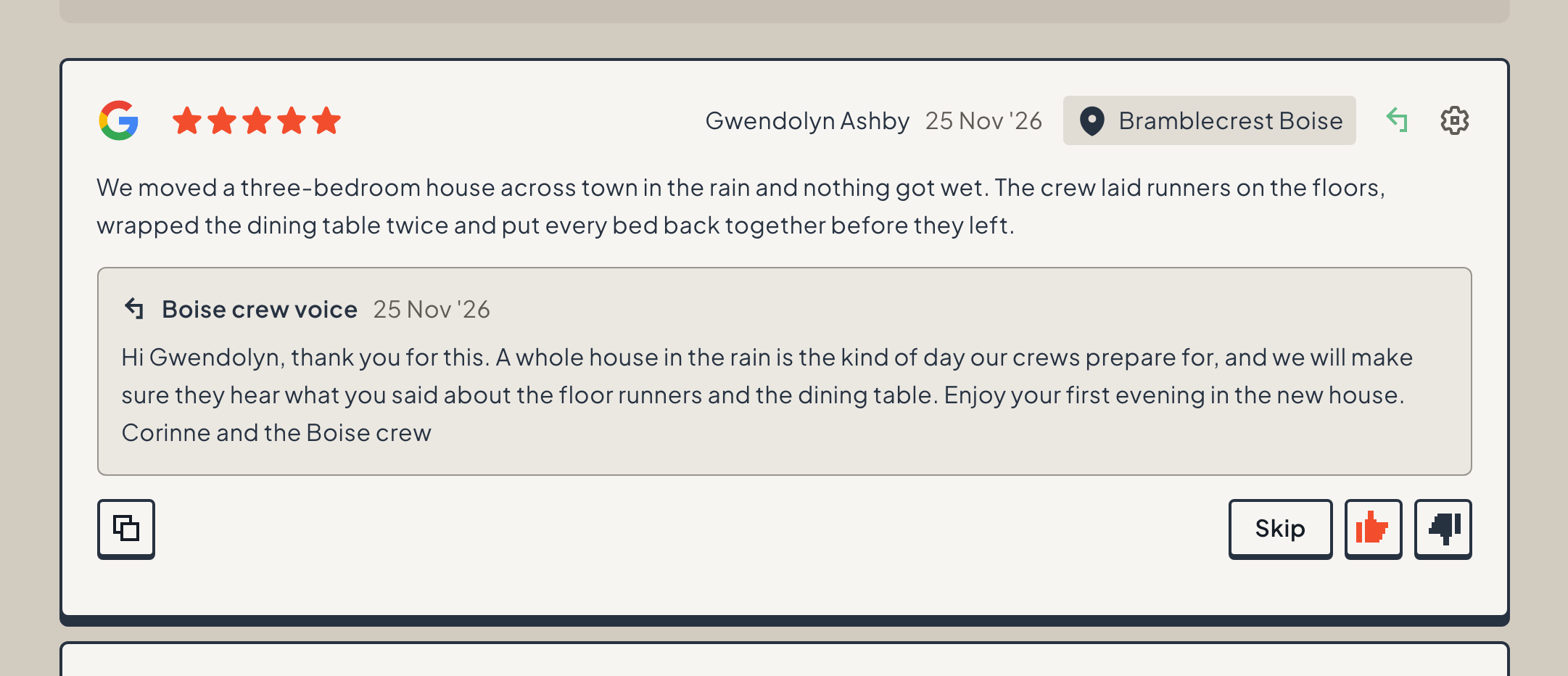
Yelp and Tripadvisor reviews get a written reply too, ready for you to post. Paid plans don't meter AI replies, so no balance needs watching. Before an agent posts anything, a backtest on your past reviews shows what it would write. See AI replies.
Each manager answers from the alert. Every alert has its own filters, by review profile, star rating and language, and its own destination: an email address, a Slack channel or a Teams channel.
Rank your people, not just your locations
Reviewflowz finds who earned each review from the name in it, that employee's own QR code or the contact owner in your CRM, then ranks the team.
Managers reply from Slack, from Teams or inside the alert email, and the reply posts on Google or Facebook. Edited and removed reviews arrive as updates, so a manager can see why a rating moved. See review alerts.
The request goes out after every visit. Every plan sends review requests by text, email or WhatsApp, in a sequence of up to three messages that stops once the customer has reviewed. On Premium, a finished job, booking or sale in the system you already run starts the sequence by itself. See review requests.
A small company that builds around you. We're bootstrapped: the people who pay for Reviewflowz are its only investors, and I still take most customer conversations myself. If your locations are reviewed on a site of your trade we don't cover yet, we add it within two weeks.
If you need a deeper link to the system you run, or something built around how your locations work, you ask the people who build Reviewflowz directly, never an account rep. The same people answer support on chat and email, 24/7, in under two hours on average.
You pay by the month or by the year, and switching plans or cancelling happens inside the app on any day, with no notice to give.
Pricing starts at $45 a month for a single location, billed yearly, and each extra location brings the per-location rate down. Staff credit and requests sent from your own system are part of Premium, and each text or email is charged by the message. See pricing.
I'll be straight about the bill, though. From about ten locations, Synup's bands cost less than Reviewflowz and include listings and social posts, so switch for the review work, not to save money.
Who it's for: multi-location businesses that collect a lot of reviews and want AI replying to every one, while every review is traced to the staff member behind it and every manager answers from the alert. Synup can keep the listings and social posts.
#2 GatherUp
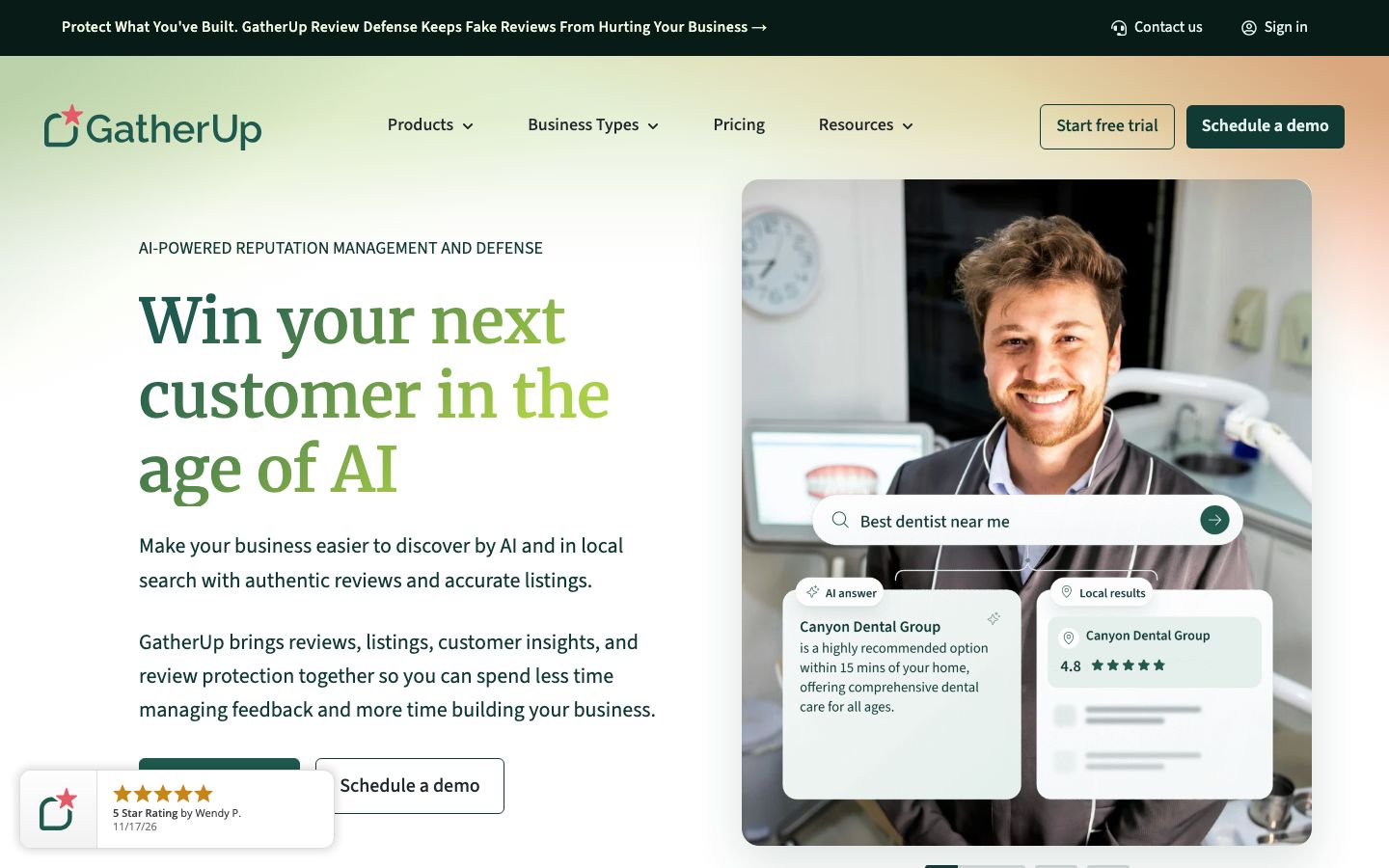
GatherUp does the review part of Synup's job and leaves out the listings, social posts and SEO. Requests go out by email and SMS, new reviews are tracked across the usual sites, and AI drafts the replies, for single-site and multi-site local businesses alike. Agencies can rebrand it as their own.
Reviewflowz or GatherUp?
GatherUp tags staff when keywords you enter turn up in a review, and it reaches most job and booking systems through Zapier. On Premium, Reviewflowz gives each review to whoever handled the job, booking or sale behind it, and sends the request from that same system. Each location can also answer in a voice of its own.
For a Synup customer, the AI is the first difference. Above a star rating you pick, AutoReply publishes AI replies to positive Google and Facebook reviews without waiting for anyone, and every plan includes the AI, with no cap published.
The price covers up to 300 SMS and 3,000 emails per location each month, and there's no cap on users. Connected to HubSpot or Salesforce, it pulls customers into a campaign automatically. Alerts can be narrowed to certain ratings and sites, and the website widget adds review schema to first-party reviews.
For a business with 10 to 50 locations, the gaps start with staff. Credit rests on tags: Auto-Tagging applies one when keywords you choose appear in a review, on Pro and up, and the other tags are added by hand.
Only positive reviews get an automatic reply, and only Google and Facebook take replies from inside GatherUp. Slack and Teams receive new feedback only by way of Zapier, and past ten locations, pricing goes through sales.
The price is published: $99 per location per month on the annual plan, and $124 paying monthly. Ten locations cost $600 a month at the annual rate. You get 14 days free without a card, and choosing the annual rate commits you for a full year, even when you pay monthly.
Who it's for: local businesses, and agencies reselling to them, that want a tool focused on reviews, with SMS and email included and automatic AI replies to their happy Google and Facebook reviewers, and no listings bundle.
#3 Birdeye
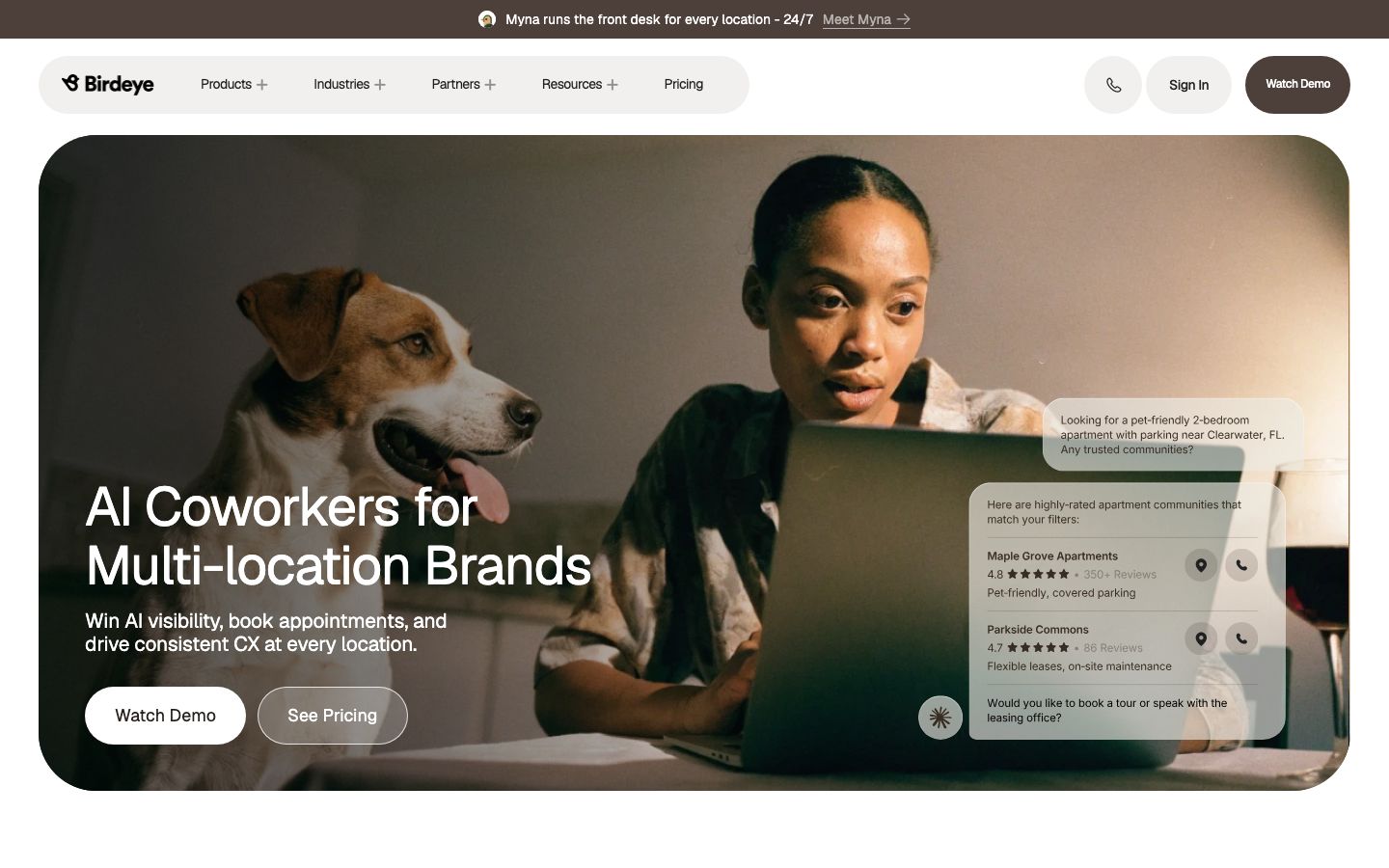
Birdeye draws the most searches of any tool here, 153,000 a month for its name. Its sweet spot is the business with roughly 10 to 250 locations, and what its customers mostly come for is more reviews, with listings and customer messaging in the same account.
Reviewflowz or Birdeye?
Birdeye tags employees by the names in a review, and needs the surname too when two staff members have the same first name. On Premium, Reviewflowz reads nicknames and misspellings as well, and a review without a name goes to the person on the job or CRM record. It sells reviews only, and its builders answer you directly.
On the review work Synup leaves to a person, Birdeye covers a lot, starting with staff. It tags the employees that reviews mention, and a leaderboard shows how each one is doing. Its AI review agent posts replies on its own or after an approval, and each location can carry its own brand identity.
Your team can answer Yelp reviews from its dashboard as well as Google and Facebook, and you choose which star ratings and sites raise an alert. A completed job or sale in ServiceTitan, Housecall Pro, Jobber, Square or Toast can trigger the request, and you can A/B test the message.
We read 572 positive Birdeye reviews posted over the last two years. Of those, ease of use earns praise in 315 and features in 312.
The weak spots for this buyer: Birdeye's documents describe matching on first and last names, not on nicknames or typos, and replies are generated from the review and your brand settings instead of your published replies.
Slack and Teams only get alerts by way of Zapier. And the reviews come with 21 other products, which pays off only if you use them.
Birdeye publishes no price and sells by quote. One third-party pricing site estimates $299 per location per month. The terms renew each agreement for another full term unless you send written notice at least 90 days before the end, make payments non-cancellable, and add an 8% fee to every renewal.
Among the 160 negative reviews we read, 55 concern the contract or cancelling.
Who it's for: groups with roughly ten to 250 locations that prefer a single platform for reviews, messaging, listings and social, bought through a rep, and that won't miss a notice date set 90 days out.
#4 Pluspoint
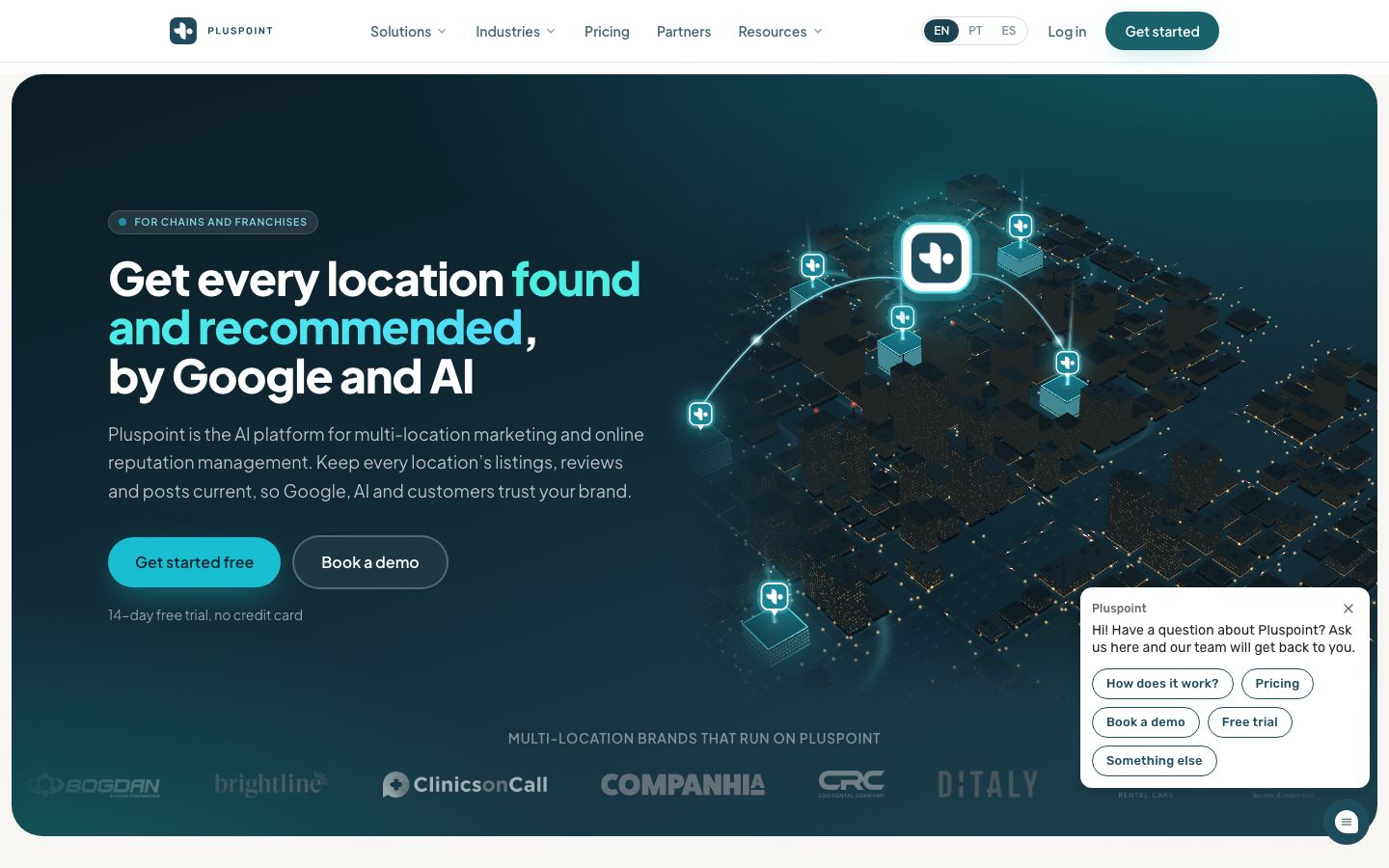
Pluspoint is the closest match here to what Synup sells, priced per location instead of by band. It handles Google listings, reviews, social posts, customer messages and surveys for chains with between 3 and 150 locations across Europe, Brazil and the US. Anything up to 30 locations can be bought online.
Reviewflowz or Pluspoint?
In Pluspoint's own restaurant case study, a waiter gets the credit when a guest scans that waiter's QR card, and Pluspoint's auto-replies post on Google only. On Premium, Reviewflowz also picks up the employee a review names, on whichever site it appears, and its AI bases every reply on what your managers have posted before.
Its AI answers in the reviewer's own language and, by star rating, publishes on its own to connected Google profiles, and review replies never touch the credit balance. Edits and deletions get flagged, and requests go out by email, by SMS through your own SMS provider, by WhatsApp or through a QR code.
A Square payment can trigger the request, reply templates are one click away, and its MCP server lets Claude or ChatGPT read your reviews and send a survey.
The weak spots for this buyer: only Google and iFood receive replies straight from Pluspoint, so on any other site the reply gets copied across by hand, and a review that no auto-reply rule matches stays unanswered.
Alerts come by email in hourly or daily batches, with no rating or site filter, and after the three included users each extra login costs $19 a month.
The list price is $29 per location per month, and billing starts at three locations, so the smallest bill is $87. Ten locations cost $290 a month, or $242 on annual billing. Pushing listings out to other directories is a $39 add-on per location.
A 14 day trial runs without a card, cancelling is done in its billing portal at any time, and past 30 locations you get a custom quote.
Who it's for: chains that want Google listings, reviews, social posts and customer messages at one price per location, get most of their reviews on Google, and need only a few logins.
#5 BrightLocal
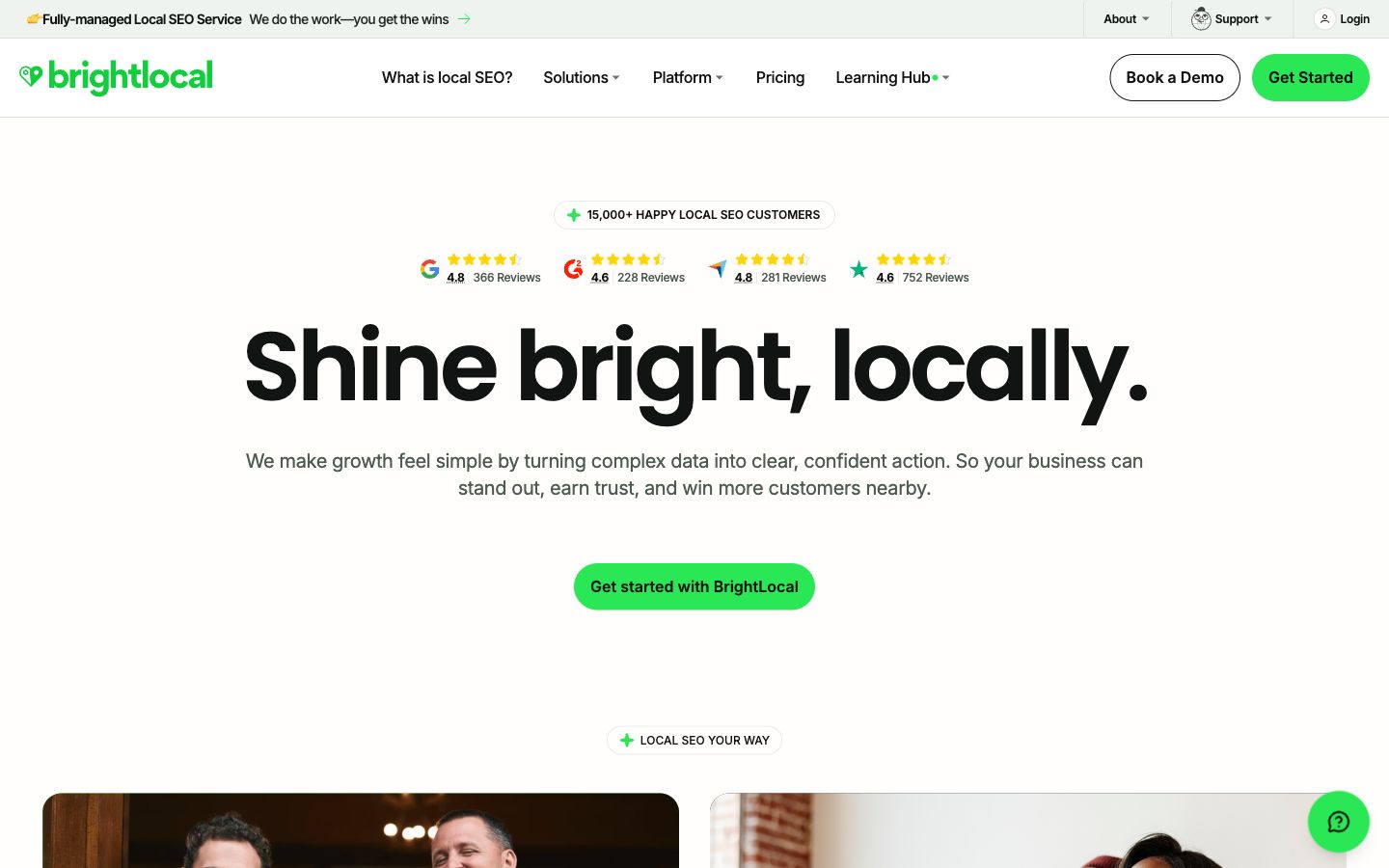
BrightLocal has built local SEO tools in Brighton since 2009. Rank tracking, a local search grid, citations, listings and audits make up most of it, and the review tools sit on Grow, its top plan. For a Synup customer, it's the like-for-like move when rankings matter as much as reviews.
Reviewflowz or BrightLocal?
BrightLocal connects to no job, booking or CRM system: its campaigns start from contacts you upload or type in, and its automatic replies are saved templates, on Google. On Premium, Reviewflowz sends each request from the system you run and credits the employee on that record, while its AI writes every reply fresh.
The price is hard to argue with: one self-serve tool, flat bands of locations up to 100, and no limit on users. With annual billing, Grow costs $49 a month for one location and $98 a month for six to ten. Paying monthly, one location costs $65.
It also has a public API, an MCP server that reads your reviews in Claude or ChatGPT, white-label reports on every plan, reply templates, and a kiosk mode for asking customers in person.
The weak spots for this buyer: review requests start from contacts you upload or type in, and automatic replies are your saved templates, posted on Google alone.
The AI only suggests a Google or Facebook reply that a person then sends, and its review alert is an email with no filter by star rating or site.
It bills monthly, you cancel from your account, and no card is needed to start the 14 day trial. Once the last paid period is over, the reports and data are no longer yours to open.
Who it's for: businesses and agencies running no more than 100 locations, for whom local search is the main job, that want reviews in the same self-serve tool at a flat band price and are happy to answer them by template or by hand.
#6 ReviewTrackers

ReviewTrackers is a review dashboard for brands with many locations. What its customers value is every location's reviews searchable in one place, so the whole team decides from the same data, and it sells listings and local rank tracking as extras.
Reviewflowz or ReviewTrackers?
ReviewTrackers sends requests from a CSV upload, a Zap or its API, and the one staff field in its help center sits on its own surveys. On Premium, Reviewflowz matches each review to a staff member by the name in it, that person's link or the HubSpot or Salesforce contact owner, and sends requests from your system.
Its AI writes replies from templates you scope to a group of locations, and they post on their own, by star rating, on the sites it's integrated with, Google, Facebook, Trustpilot and Booking.com among them.
When a location is added, it scans the review sites for its whole history, and alerts can be set by rating, by source and by keyword. There's no limit on users, each account has its own Customer Success Manager, and a free 30 day account needs no card.
The weak spots for this buyer: review tags come only with the enterprise package, and the AI starts from the review and an editable prompt rather than your published replies. Automatic replies go out with no approval stage.
SMS requests cost extra, at 100 credits a location a month, and Slack alerts depend on Zapier.
The entry price is $89 per location per month on annual billing, and $40 per location once you reach ten. The order form sets the term, and it rolls over unless your written notice reaches ReviewTrackers a full 30 days ahead. If you leave early, the remaining fees are still due.
Who it's for: brands with many locations whose main job is reading and reporting on reviews, that want a published price, a month to try it, and AI replies on more sites than Google and Facebook.
#7 Chatmeter
Chatmeter, now sold as Alchemer Reputation Management, offers reviews, listings, local pages, social and surveys to brands running somewhere between 15 and 900+ locations. Customers pick it for one view of every location's reviews across many sites, plus their listings.
Reviewflowz or Chatmeter?
Chatmeter's reviews carry the tags you apply yourself, and its campaigns fill from a spreadsheet, a form link or SFTP file uploads. On Premium, Reviewflowz ties every review to the staff member who earned it and sends the request from the system each location runs. Ask for a site Reviewflowz doesn't cover yet, and it's connected within two weeks.
Replies go out from a single screen to Google, Facebook, Yelp, Trustpilot and other sites. As of March 2026, rules on location, source, rating and review type let its AI publish replies unattended, in the voice of your earlier replies, and users who need sign-off are routed through an approval.
Edited and deleted reviews are marked, keyword notifications are built in, and the per-location price includes as many users as you need, plus a Customer Success Manager.
For 10 to 50 locations, the drawbacks are practical: AI replies sit in the Reputation Premium package, and review notifications come by email or in the app rather than in Slack or Teams.
Buying starts with a demo and a per-location proposal, with no published price and no free trial.
Vendr puts the median contract at $14,070 a year without saying for how many locations. Unless your order form says otherwise it lasts three years, fees are non-cancellable, and it renews a year at a time unless you send written notice 60 days ahead.
Who it's for: brands running dozens or hundreds of locations that want one vendor, with a success manager, for reviews, listings, local pages and surveys, and are comfortable committing for several years.
#8 Uberall
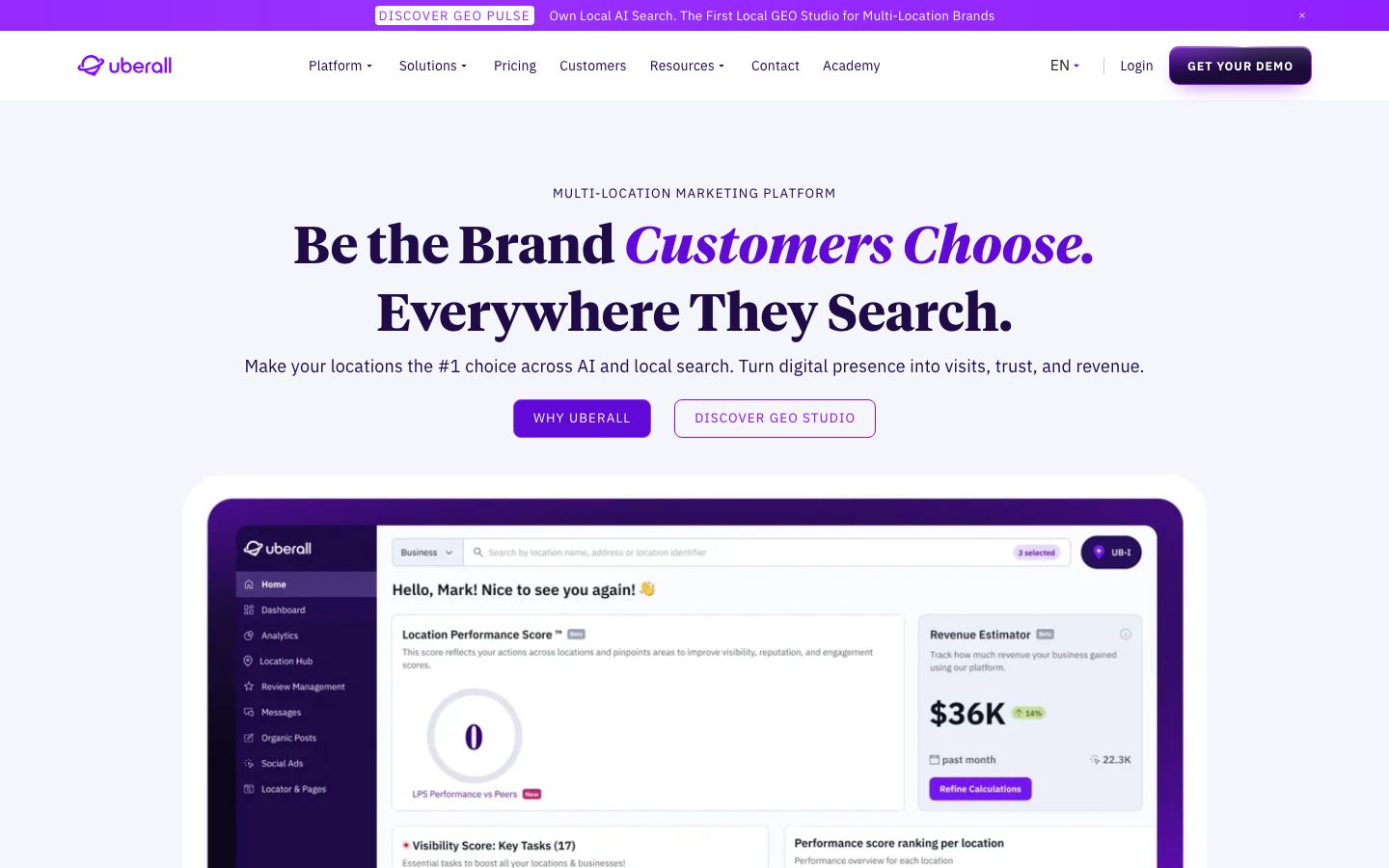
Uberall started from listings. Its core job is keeping a chain's location data right in every directory, and a store locator, local pages, social posting and a reviews module are built around that. Its customers buy it for listings data and as one place to post review replies.
Reviewflowz or Uberall?
Uberall's sentiment dashboard files staff comments under a Service and Staff theme, beside a ranking of locations, and it replies on its own only to Google reviews with stars and no words. On Premium, Reviewflowz credits the employee a review names, and your rules can answer reviews with text unattended.
It's aimed at brands with 25 or more locations. Your team answers Google, Facebook, Trustpilot, a set of local directories and, on Enterprise, Yelp from one inbox. That works from its mobile app too, and in bulk, up to 40 reviews at a time.
Its AI drafts can follow brand guidelines per location and learn from your previous replies. Email alerts arrive instantly or as a daily digest and can be filtered by rating and directory, users aren't capped, and an account manager is named for you.
The weak spots for this buyer: a review with any text in it always waits for a person, the bulk AI replies, brand guidelines and translation come with the Reviews Plus add-on, and approvals come with Collaborate Plus.
Pricing is by quote, the platform has no free trial, and its standard terms include a one-time setup fee. Billing is annual unless the order says otherwise, renewal is automatic without written notice 3 months ahead, and the terms let fees climb every year by the higher of US CPI and 5%.
Who it's for: chains with 25 locations or more that buy listings, a store locator and local pages from a single vendor, want review replies in that same inbox, and are fine with yearly terms.
Before you move anything, two practical checks. First, list every review site your locations appear on and confirm the tool you pick covers each one.
Second, Synup's terms give you no export right when you leave, and its new app has no review export, so ask support for anything you want to keep before you cancel. The reviews and your replies to them never leave Google, Facebook and the other sites.