
8 Best Review Management Software for Solar Installers
 By Axel

A solar installer earns its review months after the sale. The homeowner signs, then waits through permits, the install, the inspection and the utility's permission to operate, and only the first bill shows that the system pays.
That is when to ask, by text first, for a review on Google, with SolarReviews and EnergySage close behind. The rep who sold the system and the crew who put it on the roof both earned it.
This post sorts eight review tools for solar companies into three kinds:
- Review request tools that connect to your CRM: Reviewflowz, Podium and NiceJob. Each one sends review requests by text and email and connects to software installers already run. Reviewflowz suits installers with several offices and a busy review feed that want an answer on every review and each one tied to the sale. Prefer Podium if your sales team works every lead by phone and text from one inbox, and NiceJob if you want a referral program running beside the review asks.
- Tools built around the solar project and the crew: Bodhi, Realwork and ReviewBuzz. Prefer Bodhi if you want homeowners updated at every stage from contract to PTO, with surveys before the review ask. Prefer Realwork if you win jobs street by street and want each review pinned to the job on a map. Prefer ReviewBuzz if your crews ask in the home with tap cards and you want a coach to train them.
- Bigger packages, for a full suite or replies written for you: Birdeye and Widewail. Prefer Birdeye if you want listings, messaging, surveys and social posts from the vendor that handles your reviews. Prefer Widewail if you want a team of people to write your review replies.
What to look for in review management software for solar installers
Six things decide whether a review tool works for a solar company.
- A request that waits for the system to be switched on, sent from the CRM that tracks the project. Permission to operate comes a median 93 business days after the contract for a small home system, by NREL's 2024 count. A Utah installer asks only once the first bill is in, 30 to 45 days after activation. So the ask has to fire from the stage in HighLevel, HubSpot, Salesforce, Enerflo or JobNimbus that marks the system as on, often PTO.
- A text first, then email. The same Utah installer texts first, calls about the warranty papers, then keeps in touch with periodic emails. Under FCC rules, a commercial text needs the homeowner's written consent, and anyone can opt out whenever they like.
- Google, SolarReviews and EnergySage in one feed, with a say in where each homeowner reviews. EnergySage tells shoppers to read reviews on Google, the BBB and its own marketplace, and Solar United Neighbors adds SolarReviews, which has collected 33,992 company reviews. A Utah installer's advice is to send customers to SolarReviews as well as Google, with EnergySage as a further option.
- Reviews you can reuse to sell the next system. A homeowner can't test a system before buying, so other homeowners' words do the convincing. In Aurora Solar's 2026 survey, 54% of US homeowners said they look hardest at reviews and testimonials when they choose an installer. A Texas installer sends commercial prospects straight to its Google reviews.
- A link or QR code for the closeout visit. A San Diego installer sends a technical representative to close out each job and ask the homeowner, face to face, for a review and a referral. A permanent review link or a QR code is what that visit can hand over.
- Referrals asked for at the same moment. Over 70% of the 501 installers in an EnergySage survey rely on referrals often, and an Iowa contractor pays its customers for them. A tool that asks for the referral right after a good review saves a second message.
How we ranked them: by how likely an installer is to come across each tool while choosing review software, weighed by the partners its CRM and project software list and the solar customers each vendor names, then by how well each one does the six jobs above.
CRMs that bundle a review module, HighLevel among them, and the review sites themselves are not on the list.
The 8 best review management software for solar installers at a glance
| Tool | Best for | Starting price | Contract | Standout for solar installers |
|---|---|---|---|---|
| Reviewflowz | Solar companies with several offices and a steady flow of reviews that want AI to answer every one | From $45 a month for a single location, billed yearly | Cancel or downgrade in the app, no notice period | Asks when a JobNimbus job reaches the status you tick, and credits the sales rep |
| Podium | An installer whose sales team works every lead by phone and text, with review invites sent from the same inbox | $399 a month (Core) | 12 months, renews unless cancelled 30 days ahead | Invites from closed HubSpot deals, and a referral text after each 5-star review |
| NiceJob | A small installer that wants a referral program beside its review asks, on a monthly plan | $95 a month (Starter) | Month to month, cancelled by contacting the team | Homeowners on a won HubSpot deal enrolled for review asks by text and email |
| Bodhi | A residential installer that wants homeowners kept up to date at every stage, from contract to PTO | Free up to 5 new projects a month, paid packages on quote | Paid packages invoiced in 12 monthly installments | Satisfaction surveys at project milestones, with the Google review ask after a high score |
| Realwork | An installer that wins jobs street by street and wants each review pinned to its job site | Quote after a demo | Set in the order, then renews month to month | Reviews geotagged to the job and shown on neighborhood maps on your website |
| ReviewBuzz | An electrical or roofing contractor with a solar division whose crews ask in the home with tap cards | $250 a month plus $25 per field employee | 12 months in its terms, 30 days' notice | Cards, badges and QR codes for the in-home ask, with ServiceTitan built in |
| Birdeye | A solar company that wants listings, messaging, surveys and social posts from the vendor that handles its reviews | Quote only | Set per order form, 90 days' notice to stop renewal | Native connections to HighLevel, HubSpot, Salesforce and JobNimbus |
| Widewail | An installer that wants a team of people to write every review reply | $500 a month per location (Core) | Month to month or 12 months, 30 days' notice | Replies written by its own specialists on Pro |
Ask every homeowner once the system is on
See how Reviewflowz sends the review request when a JobNimbus job reaches the status you pick, by text and email, and credits the rep who sold the system.
The 8 best review management software for solar installers
Ratings are the scores shown on G2, Capterra and Trustpilot in November 2026. A site is left out where the tool has no rating there.
#1 Reviewflowz
- Best for: Solar companies with several offices and a steady flow of reviews that want AI to answer every one, and each review tied to the sale.
- Pros:
- A JobNimbus job reaching the status you tick sends the request, by text or email.
- Google, Facebook, Yelp and BBB reviews land together, with an AI draft for each.
- Each review credited to the JobNimbus sales rep or the HubSpot contact owner.
- Cons:
- Reviews only: it sells no phone line, text inbox, payment tool or listings.
- The CRM connection and staff credit come with Premium.
- G2: 5.0 out of 5 (9 reviews)
- Capterra: 4.8 out of 5 (25 reviews)
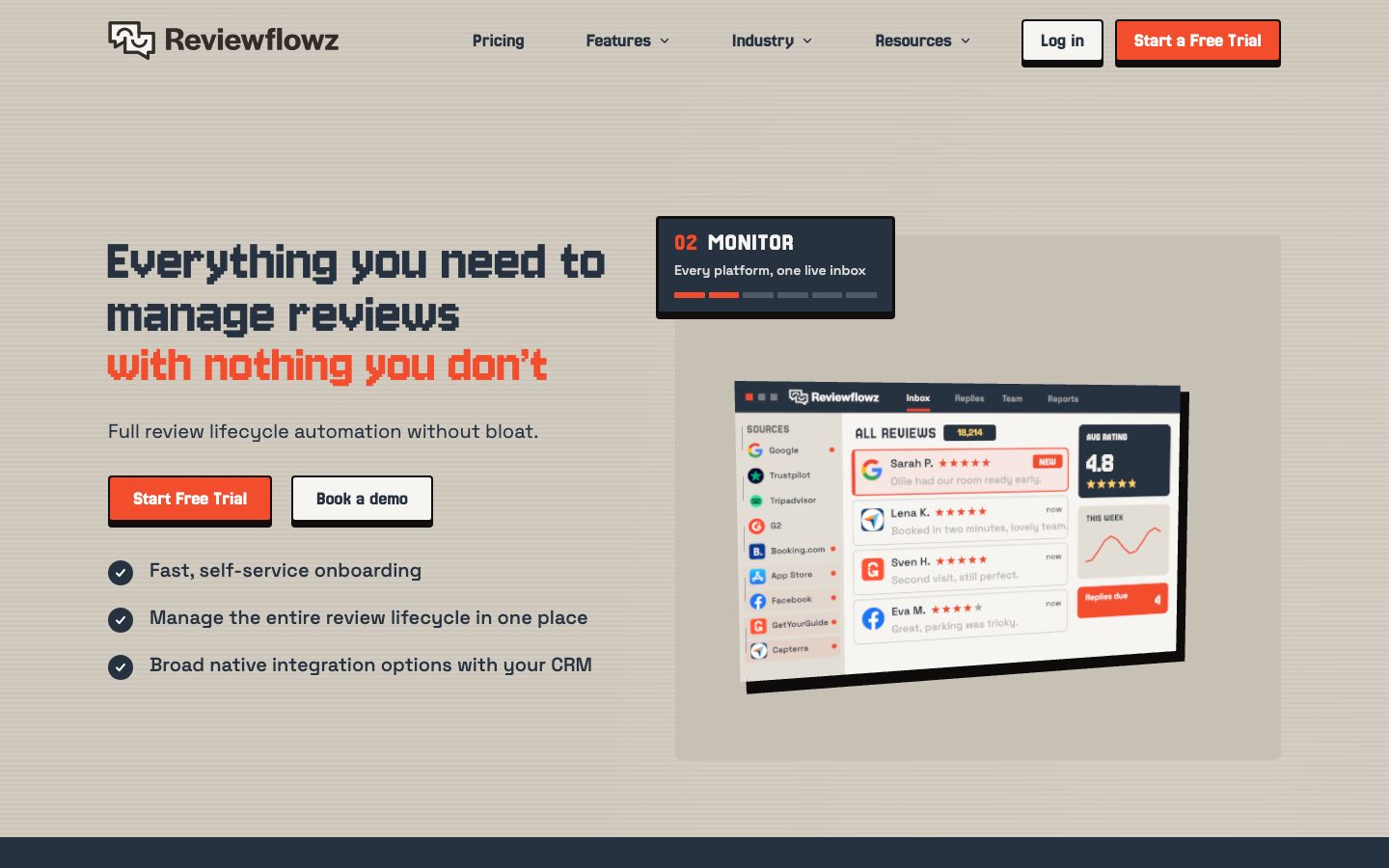
Reviewflowz does reviews and nothing else. It asks every homeowner, watches every site, credits each review to whoever earned it, and writes a draft answer. It pays off at a solar company with several offices, where nobody has time to chase, sort and answer reviews by hand once the systems are on.
The ask starts from the project record. In JobNimbus you tick the job status that means the system is producing, PTO received for example, and Reviewflowz asks the job's primary contact after the delay you set. Setup is in the JobNimbus integration guide.

Each request carries up to three messages with their own delays, so a text can go first and an email follow. The sequence stops once the homeowner reviews, clicks or unsubscribes.
Without JobNimbus, you upload the list of homeowners whose systems went live, or hand over the QR code at the closeout visit. A contractor whose solar division runs on ServiceTitan, Housecall Pro or Jobber starts the request from the job record there instead.
Every review lands in one feed: Google, Facebook, Yelp and the BBB, the sites homeowners read before they sign. Each answer is drafted by AI from the replies you have already published, so it sounds like your office.
Your rules post the thank-you on Google and Facebook, while a two-star review waits for a person. For Yelp and the BBB, you get the draft to post yourself.
The reviews then help sell the next system. Search them by rating, topic, salesperson, office or date, and copy the text or the link straight into a proposal or a post. For the closeout visit, a permanent review link and its QR code send the homeowner to the site you choose and count every click.
Credit follows the sale. On Premium, a review matched to a JobNimbus job goes to that job's sales rep, and HubSpot and Salesforce connect so that a review matched to one of their contacts goes to that contact's owner.
Reviewflowz also finds a rep's or installer's name in the review text, misspelled or shortened, and each rep or installer carries a personal QR code in the companion app.

Reviewflowz is a small, self-financed company that bends to the trade it serves. A site you need, SolarReviews or EnergySage for example, is added within two weeks of asking. Integrations go past a simple trigger, a missing one gets built on request, and you deal directly with the people who build the product.
You cancel or downgrade in the app whenever you like, with no notice period. Plans start from $45 a month for a single location, billed yearly, and the price per location falls as you add offices. A 14-day trial needs no card.
#2 Podium
- Best for: An installer whose sales team works every lead by phone and text and wants review invites sent from that same inbox.
- Pros:
- Review invites go out from closed HubSpot deals, and from Salesforce through workflow rules.
- Calls, texts, web leads and review invites share one inbox.
- Referral Automation texts a referral ask after each 5-star review, on every plan.
- Cons:
- A 12-month term, renewed unless cancelled in writing 30 days ahead.
- Its help center lists Yelp among the sites that allow no third-party sync.
- Auto-posted AI replies come with Pro or a paid add-on.
- G2: 4.5 out of 5 (2,159 reviews)
- Capterra: 4.2 out of 5 (527 reviews)
- Trustpilot: 4.1 out of 5 (411 reviews)

Podium is a phone, texting and inbox platform for local businesses, and review invites sit inside it as one module. Its features draw the most praise: 179 of the 295 positive reviews read mention them. Its one solar case study is about Voice AI catching after-hours calls and routing the leads.
Reviewflowz or Podium?
Podium gives a review to the staff member whose invite the homeowner clicked, if the review follows within 14 days, or to someone the text names. On Premium, Reviewflowz credits the rep on the JobNimbus job or the HubSpot contact owner, even when the review names nobody.
On solar's systems, a closed deal in HubSpot sends Podium's text invite, Salesforce administrators can build workflow rules that send it, and its JobNimbus integration asks after a job is completed. Podium sends one reminder. Its help center names Yelp among the sites that allow no third-party sync, so Yelp stays outside its review feed.
Core runs $399 a month. Its contract lasts 12 months, is billed for the year up front unless agreed otherwise, and cannot be ended early. Contracts and cancelling top the complaints, raised in 26 of the 67 negative reviews read. Its site: podium.com.
#3 NiceJob
- Best for: A small installer that wants a referral program beside its review asks, on a plan billed month to month.
- Pros:
- A won HubSpot deal enrolls the homeowner for review asks by text and email.
- Up to three follow-ups, stopped once the homeowner reviews.
- Pro adds referral campaigns that ask happy homeowners to send a friend.
- Cons:
- Its help center lists 7 review sites to connect, and Yelp is not one.
- AI replies cover Google only, and posting them on their own needs Pro.
- Each office with its own Google profile needs a separate license.
- G2: 4.8 out of 5 (437 reviews)
- Capterra: 4.9 out of 5 (203 reviews)
- Trustpilot: 3.3 out of 5 (26 reviews)
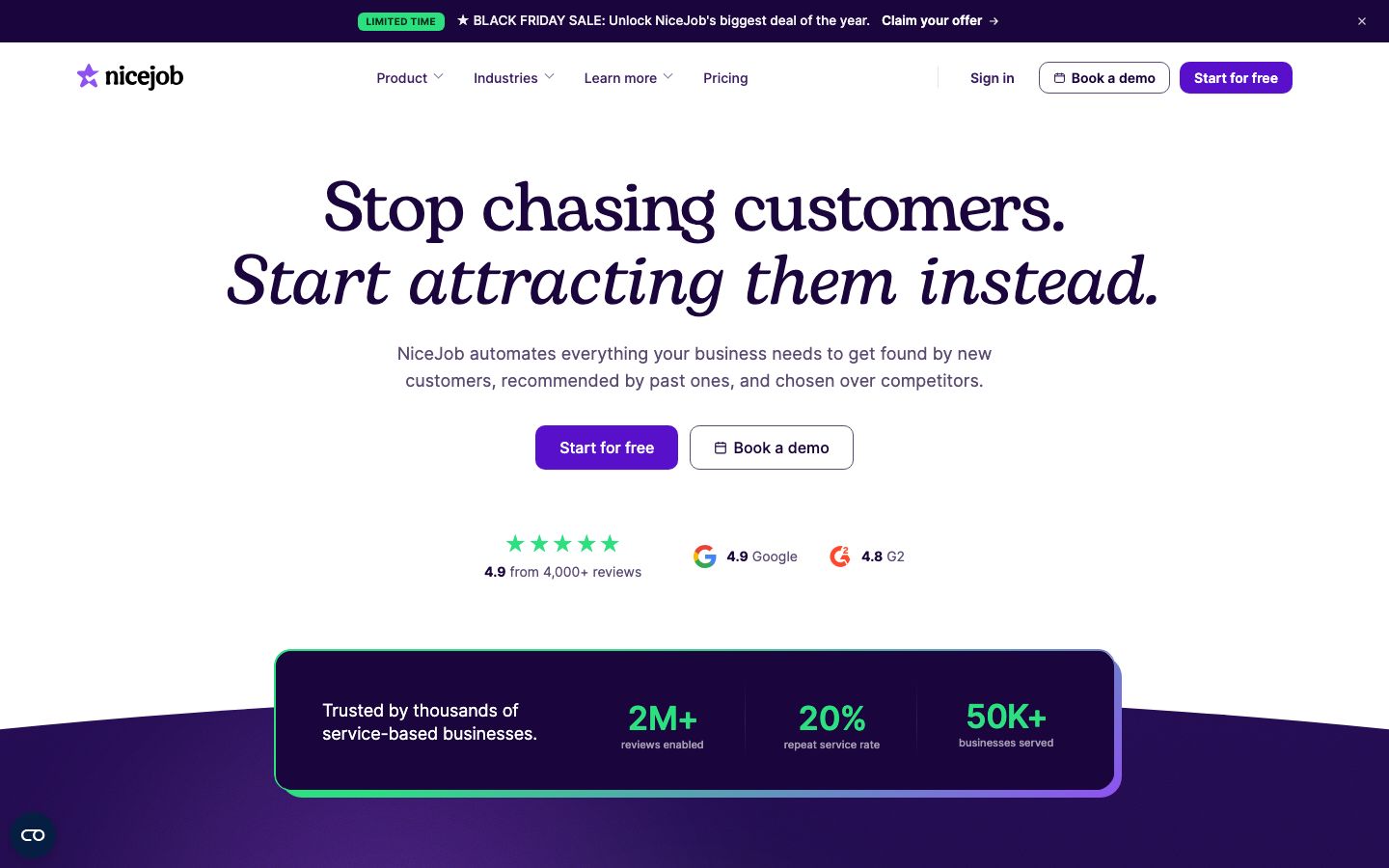
NiceJob was built for home service trades. When a job is marked done, it sends the homeowner a text or an email asking for a review and follows up on its own. Solar installers use it too: a search of nicejob.com finds review pages for 16 solar businesses, roofing and solar firms among them.
Reviewflowz or NiceJob?
A homeowner comparing installers reads the BBB and Yelp as well as Google, and NiceJob's AI answers only the Google ones. Reviewflowz writes a draft for every review on Google, Facebook, Yelp and the BBB, and your rules publish it on Google and Facebook.
On solar's systems, NiceJob connects natively to HubSpot, where homeowners with a won deal in the last 14 days are enrolled, and through Zapier to Salesforce and Zoho CRM. On Pro, a referral campaign asks homeowners who left 4 stars or more to pass your name on, in a trade where referrals bring much of the work.
Starter costs $95 a month and Pro costs $135 a month, billed monthly. To cancel, its help center tells you to contact the team. More on get.nicejob.com.
#4 Bodhi
- Best for: A residential installer that wants homeowners kept up to date at every stage, from the signed contract to PTO.
- Pros:
- Built for solar: project updates by text, email and app, triggered by CRM milestones.
- An NPS survey and the Google review ask go out together by text.
- Referral asks go out at key moments, such as after PTO.
- Cons:
- Automated review and referral requests need a paid package, priced on quote.
- CRM-triggered updates need Pro and a CRM or project tool already in use.
- A score of 8 or lower gets a feedback prompt before the Google link.
Bodhi is customer experience software for solar installers. It keeps the homeowner informed between the signed contract and permission to operate, with a branded portal, a team inbox and automated updates. OneEthos bought it in March 2026, and Solar Power World reports that it has supported more than 30,000 solar installs.
Reviews come out of that journey. Bodhi texts a satisfaction survey at the stages you set, and a homeowner who answers 9 or 10 gets the Google review link at once. A lower score brings a request for written feedback, and your team has two weeks to act on it before Bodhi sends the link.
Referral asks follow at moments such as the final design and PTO.
On Pro, Bodhi connects to Salesforce, HubSpot, Sunbase, Zoho and JobNimbus, and Scoop syncs project statuses with it. Bodhi Free costs nothing for up to 5 new projects a month. Starter and Pro come in project packages from 50 projects up, invoiced in 12 monthly installments. More on bodhi.solar.
Start with the systems you switched on this month
Try Reviewflowz free for 14 days, with no card, and send your first requests to homeowners whose panels already produce.
#5 Realwork
- Best for: An installer that wins jobs street by street and wants each review pinned to its job site, with photos, on a map.
- Pros:
- Review requests fire from JobNimbus, ServiceTitan or Jobber job workflows, by text or email.
- Reviews are geotagged to the job site and mapped on your website.
- Crews can collect a review in person through its mobile app.
- Cons:
- No pricing page: the price comes after a demo.
- Requests send homeowners to Google or Facebook, at their choice.
- G2: 5.0 out of 5 (2 reviews)
Realwork is software for home service businesses that turns each finished job into local marketing. The job's photos, its review and its address go on a map of the neighborhoods you work in. Solar is on its list of supported trades, and Realwork says more than 20,000 pros use it.
For an installer who sells by pointing to the systems already on the street, that map is the product. Requests go out on their own from the job workflow in JobNimbus, ServiceTitan or Jobber, and crews can capture a review on site with the app.
AI drafts each reply, and RealWork XM, a newer product, has AI call the homeowner the day after the job for feedback and a review.
Realwork has no pricing page and sells through a 30-minute demo. Its terms renew an order month to month once the first term ends. More on realworklabs.com.
#6 ReviewBuzz
- Best for: An electrical or roofing contractor with a solar division whose crews ask homeowners in person, with tap cards and badges.
- Pros:
- Tap cards, badges and QR codes let crews ask at the closeout visit.
- ServiceTitan sends its review request once a job is completed.
- Each crew member gets a review portfolio to show homeowners in the home.
- Cons:
- HubSpot, HighLevel and JobNimbus reach it only through Zapier.
- A 12-month term in its terms, ended only by notice 30 days ahead.
- G2: 4.3 out of 5 (6 reviews)
- Capterra: 4.2 out of 5 (9 reviews)
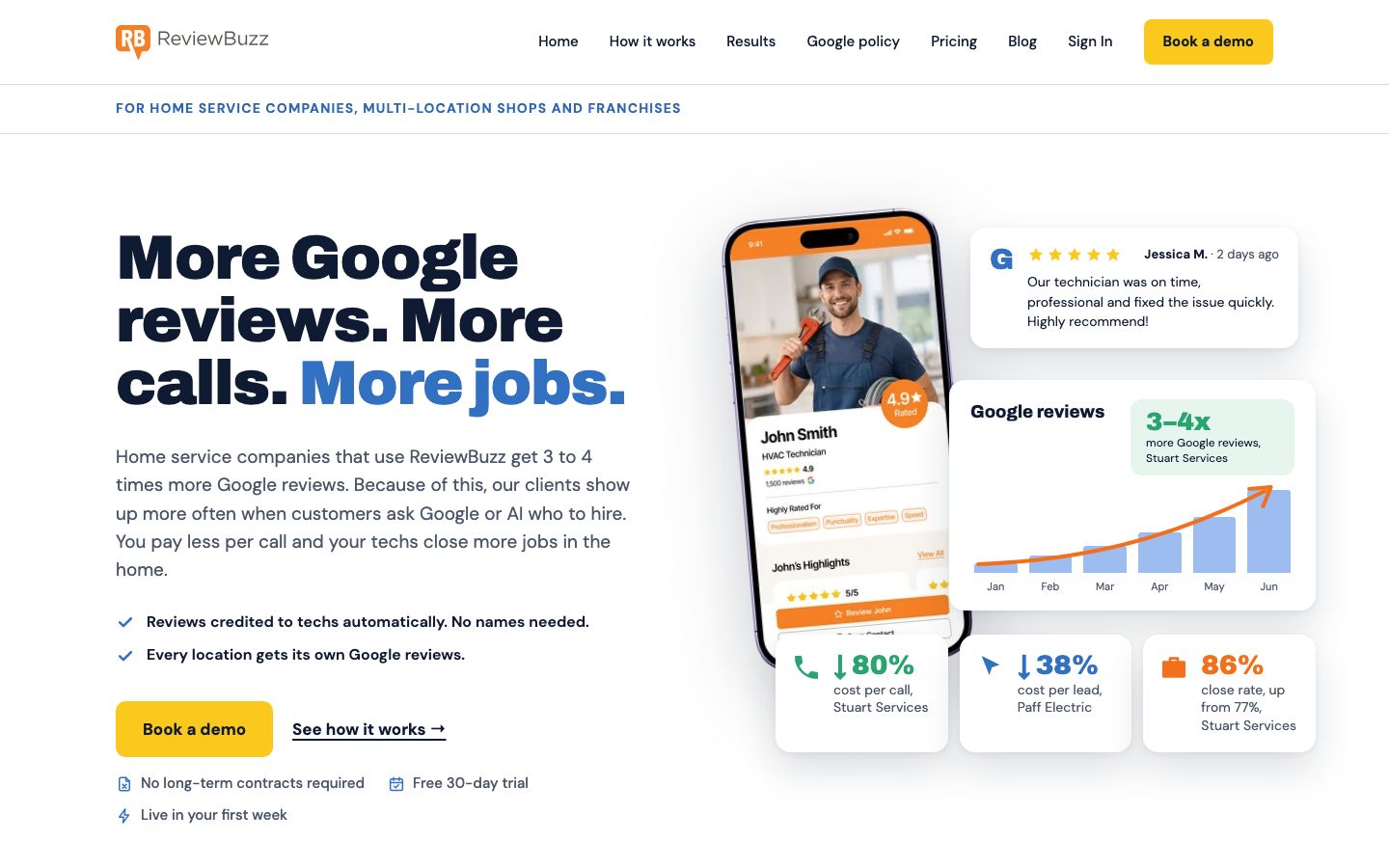
ReviewBuzz is review software for home service contractors with crews in the field, built around the ask in the home. Its customer page features Paff Electric and Solar, an electrical and solar contractor with 5 trucks that moved over from PulseM.
Reviewflowz or ReviewBuzz?
ReviewBuzz bills a monthly $250 platform fee and $25 more for every field employee, so the bill rises with each installer you hire. Reviewflowz is priced by location, whatever the size of the crew.
In a contracting business on ServiceTitan, the request goes out when the job is completed, and a Meet the Team message can introduce the crew before they arrive. HeroHub gives each crew member a review portfolio to show in the home, and BuzzMaps pins each person's reviews across the service area.
Its single plan comes to $250 a month and $25 more per field employee, one location included. The terms describe a year-long commitment that rolls over unless you write 30 days before it ends, though the site promises no long-term contract. Its site: reviewbuzz.com.
#7 Birdeye
- Best for: A solar company that wants listings, messaging, surveys and social posts from the vendor that handles its reviews, bought through sales.
- Pros:
- Native connections to HighLevel, HubSpot, Salesforce and JobNimbus send requests by text and email.
- Its ION Solar case study reports over 1,700 new reviews from texted and emailed asks.
- Reminders run one to five times, at intervals you set.
- Cons:
- Quote only, on an order form that needs 90 days' notice before renewal.
- Non-cancellable for the term, with an 8% fee added at each renewal.
- Support draws the most complaints: 56 of the 160 negative reviews read.
- G2: 4.7 out of 5 (4,327 reviews)
- Capterra: 4.7 out of 5 (712 reviews)
- Trustpilot: 3.5 out of 5 (688 reviews)
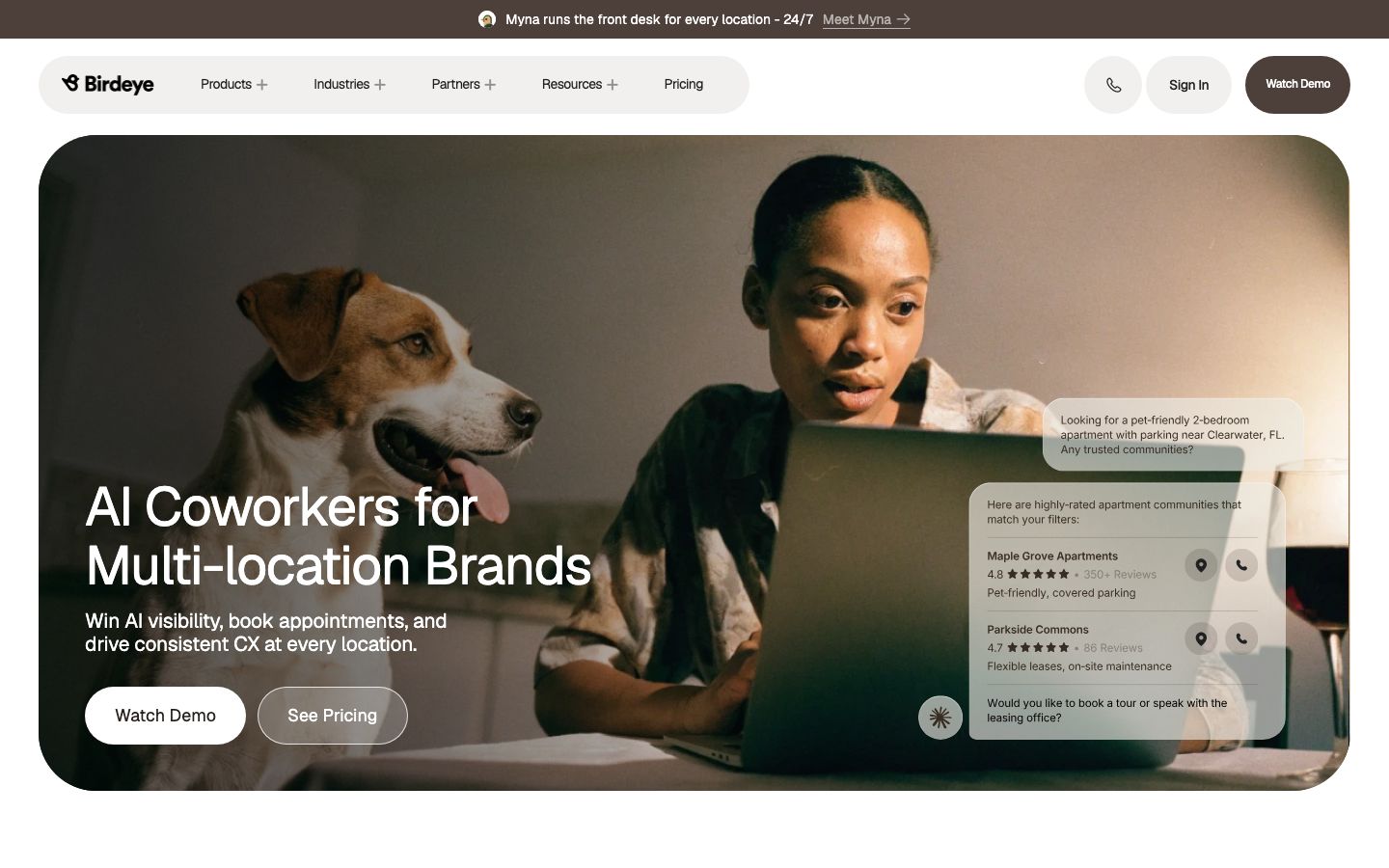
Birdeye puts reviews in one suite with listings, messaging, surveys, social posting and payments. It sells through its sales team, mostly to companies running roughly 10 to 250 locations. Of 572 positive reviews read, 315 praise its ease of use. Its features follow closely, at 312.
Reviewflowz or Birdeye?
A solar company that buys Birdeye for reviews signs for a suite of 21 products, on an order form that renews unless cancelled 90 days ahead. Reviewflowz does reviews only, and you cancel in the app with no notice period.
In solar, its case study of ION Solar, an installer with 8 locations, says texted and emailed requests sent at the best moments brought over 1,700 new reviews. Native connections reach HighLevel, HubSpot, Salesforce and JobNimbus, where a request can go out once a contact or job reaches the status you pick.
Birdeye publishes no price and quotes after a demo. Its terms make the order non-cancellable for the term and add an 8% fee at each renewal. Contracts and cancelling come second among complaints, in 55 of 160 negative reviews read. More on birdeye.com.
#8 Widewail
- Best for: An installer that wants a team of people, rather than software alone, to write every review reply.
- Pros:
- On Pro, Widewail's own specialists write the replies to your reviews.
- In its SunCommon case study, texted requests also sent homeowners to SolarReviews.
- Cons:
- Core costs $500 a location monthly, and specialist replies cost $750.
- A term that renews unless cancelled in writing 30 days ahead.
- Its terms let fees climb by as much as 8% each year.
- G2: 4.3 out of 5 (6 reviews)
- Capterra: 5.0 out of 5 (3 reviews)

Widewail sells texted review requests and review replies, written by AI on Core or by its own team on Pro. Its site now leads with car dealerships. Its solar work shows in a case study of SunCommon, a Vermont and New York installer, and in a partnership with Amicus Solar, a cooperative of 63 independent solar companies.
Reviewflowz or Widewail?
Widewail charges $750 a location a month for replies its specialists write. Reviewflowz drafts each reply in the voice of the replies you already posted, and your rules decide which ones post on their own.
SunCommon used Widewail from late 2020 to text review invitations and have every review answered by people within 24 hours. On solar's systems, Widewail sends automated requests from HubSpot and lists Salesforce among the CRMs it can connect.
Core costs $500 a location a month and Pro costs $750. Contracts are monthly or yearly (12 months), and they roll over until you give written notice 30 days before the end. More on widewail.com.