
10 Best Review Management Software for Restaurants
 By Axel
Nobody has to chase reviews in a restaurant. Diners post them on their own, on Google first, then on Yelp, Tripadvisor, OpenTable and the delivery apps, and most of them paid and left without giving you an email or a number. So the job is the volume: an answer to every review on every site, in the restaurant's own voice, and a clear read of what guests keep saying about the food, the wait and the server who looked after them.
The tools below fall into four groups. The first is review management platforms that answer every review on every site: Reviewflowz, Birdeye and ReviewTrackers. Prefer Reviewflowz if your outlets get more reviews than your managers can answer and you want every review answered by AI, with the credit going to the server a diner names. Prefer Birdeye if you also want texting, listings and social posts from the same vendor, and ReviewTrackers if you want listings and local rank tracking next to the review dashboard, at a published entry price.
The second is restaurant marketing platforms with reviews inside: Marqii and Bloom Intelligence. Prefer them if your bigger job is keeping menus and listings in sync from the POS (Marqii) or turning guest Wi-Fi sign-ins into a guest list for win-back offers (Bloom Intelligence). The third is guest feedback platforms for restaurant brands: Ovation, Momos and Tattle. Prefer one of those if you want a short survey after every order and a way to win back an unhappy guest privately, with loyalty offers (Momos) or delivery-app replies (Tattle) in the same place.
The fourth is the review module of your reservation system: OpenTable Reputation Management and SevenRooms reputation management. Prefer it if you already take your bookings there and want each review next to the guest's reservations.
What to look for in review management software for restaurants
Five things decide it for a restaurant, in this order, and Reviewflowz for restaurants, bars and cafés shows each one in practice.
- An answer to every review on Google, Yelp, Tripadvisor, OpenTable and the delivery apps. Diners review a restaurant without being asked, on several sites at once: OpenTable says its diners alone have written more than 155 million restaurant reviews, and DoorDash shows public reviews on restaurant store pages. An operator quoted by RestaurantOwner.com says each negative review left unanswered can turn away the next diner, so the software has to draft a reply for every review in your voice and post the easy ones by itself.
- What diners say about the food, the wait and the service, outlet by outlet. Restaurant tools sort reviews into the trade's own topics: Ovation uses 35+ restaurant categories, Tattle reads food quality and speed of service, OpenTable scores food, service and value. That is how you learn which dish, which shift or which kitchen draws the complaints before the next weekend.
- Every outlet side by side, for head office and for each general manager. Seven in ten US restaurants are single-unit operations, according to the National Restaurant Association. The groups that run more than one compare their outlets side by side, and each general manager needs a view of their own store with the brand's reply rules on top.
- Credit for the server, host or bartender a diner names. Restaurants already ask guests to name their server: one New Jersey chain told front-of-house staff to bring in five Google reviews a month that carry their first name. The FTC rule forbids rewards that depend on a review being positive, so the credit has to count every review that names someone, whatever the stars.
- Feedback at the table or the till, never filtered. Toast shares guest details with partner apps only for takeout and delivery orders, so the dine-in ask happens on the receipt, at the payment screen (Toast Pay, SpotOn) or after a reservation. Yelp asks restaurants not to request reviews at all, so on Yelp the work is answering the diners who write on their own.
How we ranked them: by how widely restaurants use each tool, judged by the systems that sell it to them (Toast's partner directory, OpenTable, SevenRooms), the restaurant brands that name it and how often owners search for it by name. Each entry then says what the tool does best for a restaurant and who should pick it.
The 10 best review management software for restaurants at a glance
| Tool | Best for | Starting price | Contract | Standout for restaurants |
|---|---|---|---|---|
| Reviewflowz | Restaurant groups with several outlets that get more reviews than their managers can answer | From $45 a month for a single location, billed yearly | Monthly or yearly, cancel in the app any time | An AI reply for every review, topics by outlet, credit for the server a diner names |
| Marqii | Restaurants that want menus, hours and listings pushed from their POS, with reviews in the same tool | $145 a location a month on Growth, the first plan with reviews | 12 months, 90 days' written notice | Replies post to Google, Yelp and Facebook |
| OpenTable Reputation Management | Full-service restaurants that already take their bookings on OpenTable | Sold with OpenTable's plans | OpenTable's terms | Google, Facebook and OpenTable reviews answered inside the reservation system |
| Bloom Intelligence | Restaurants that want guest Wi-Fi sign-ins turned into a guest list for win-back offers | $220 a location a month on Enterprise+, billed yearly | Contract, cancel any time in the first 90 days | AI replies on six sites, OpenTable and Tock included |
| Ovation | Quick-service and fast-casual brands that want a two-question text survey after every order | Quote only | Yearly renewal, 60 days' written notice | Unhappy guests caught in private before they post |
| Momos | Restaurant brands that want surveys, loyalty offers and reviews in one guest inbox | Quote only | Non-cancellable term, 7% higher at each renewal | Replies post to OpenTable and DoorDash as well as Google and Yelp |
| Tattle | Delivery-heavy brands that want DoorDash, Uber Eats and Grubhub reviews answered next to their post-order surveys | Quote only | Auto-renews, ends at the close of the paid term | Menu-item feedback from surveys on every sales channel |
| SevenRooms reputation management | Restaurants already running reservations and guest profiles on SevenRooms | Sold with the SevenRooms platform | SevenRooms' terms | Each review linked to the guest's profile |
| Birdeye | Groups that want texting, listings, social posts, surveys and reviews from one vendor | Quote only | Non-cancellable term, 90 days' written notice | A Toast integration that sends review, referral and survey requests |
| ReviewTrackers | Brands that want listings and local rank tracking next to a review dashboard, at a published price | $89 a location a month, billed yearly | Non-cancellable term, 30 days' written notice | A burger chain case study: review responses 75 percent faster |
Every review answered, at every outlet
See how Reviewflowz answers Google, Yelp and Tripadvisor reviews for restaurants, sorts what diners say by topic and credits the server they name.
The 10 best review management software for restaurants
Ratings are the scores shown on G2, Capterra and Trustpilot in November 2026. A site is left out where the tool has no rating there.
#1 Reviewflowz
- Best for: Restaurant groups with several outlets that collect reviews every day on Google, Yelp and Tripadvisor and want AI to answer every one.
- Pros:
- An AI reply for every review, written from the replies your managers already posted.
- Topics and sentiment by outlet: food, wait times, service, takeout and value.
- Each server, host or bartender a diner names gets the credit, nicknames and typos included.
- Cons:
- Reviews only: no menu sync, listings, texting inbox or social posting.
- Topics, staff credit and requests from Tock or Square need the Premium plan.
- G2: 5.0 out of 5 (9 reviews)
- Capterra: 4.8 out of 5 (25 reviews)
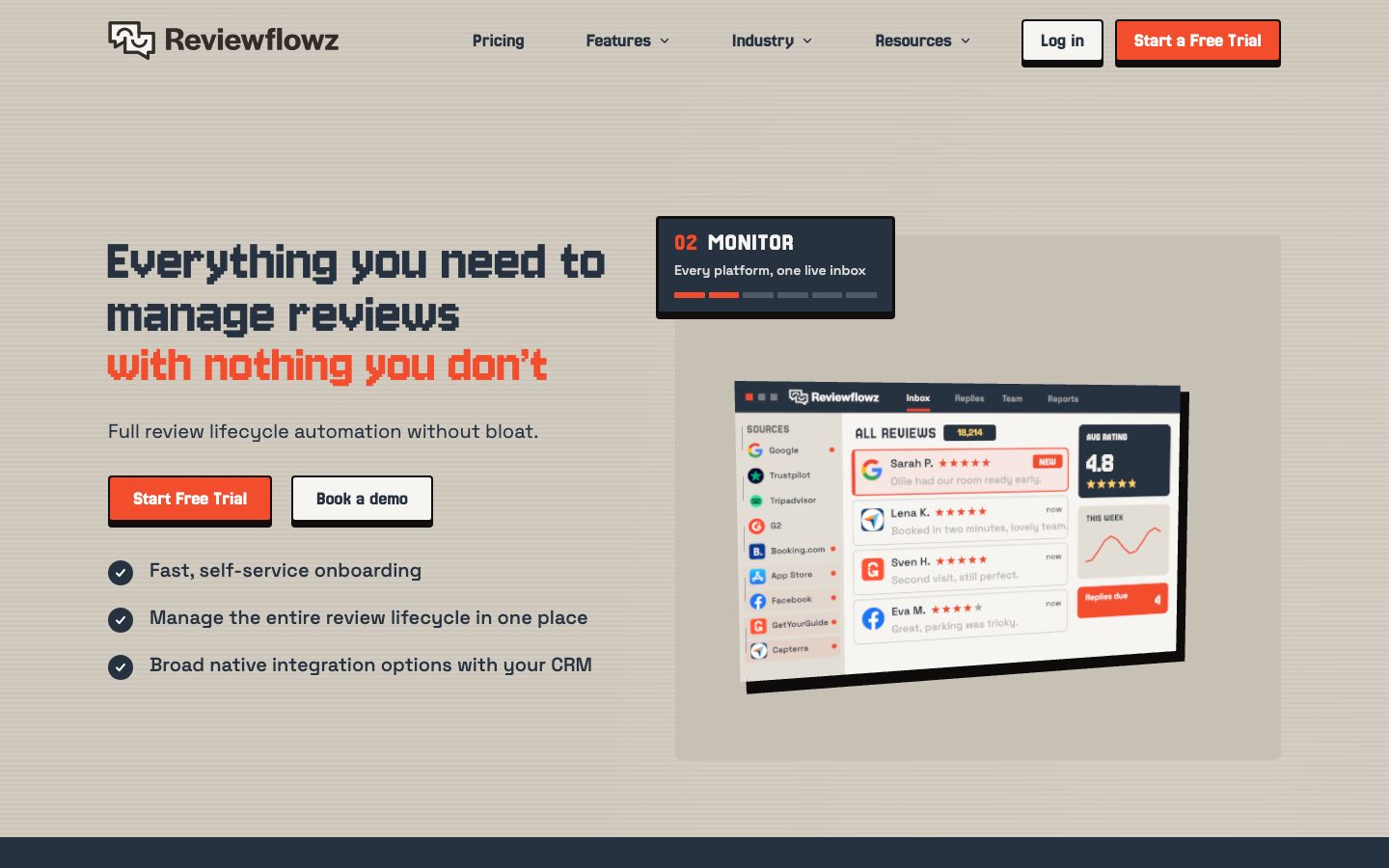
Reviewflowz is review software and nothing else, built for the problem a busy restaurant actually has: more reviews than anyone on the team has time to answer. Each outlet's Google, Yelp, Tripadvisor and Uber Eats listings feed one queue, and their past reviews come in with them, so a general manager opens one screen instead of four apps. The whole cycle runs from there: request, monitor, credit and reply.
The reply comes first. An agent trained on the thank-yous your team already posted writes a reply for every review, in the diner's own language. Your rules decide what goes out alone: for example, every 4 and 5-star Google review is answered by itself, while anything under four stars waits for the manager with a draft attached. Rules can follow the rating, the site, the outlet or a keyword, so a review that mentions an allergy always waits for a person. Yelp, Tripadvisor and Uber Eats reviews get the same draft, ready to paste. See how the replies work.

Then the reading. Reviewflowz pulls out each topic a review mentions, from the food to the wait to the takeout counter, and scores every excerpt as positive or negative, outlet by outlet and month by month (Premium). A ranked table puts each outlet's Google rating, review count and reply time side by side, with the top complaint under the one that trails, ready for the Monday meeting.

Restaurants already ask guests to name their server, and Reviewflowz turns that into a credit for each person (Premium). It reads every name a diner writes, nicknames and typos included, gives each server, host or bartender a QR code of their own, and on Tock credits the server on the reservation, or on Square the team member on the payment. The three methods add up on one ranking per outlet, and it counts every review that names someone, whatever the stars.
When you do want to ask, each outlet gets its own QR code for the table and the receipt, and a connected Tock or Square account sends the request after the visit (Premium).
Reviewflowz is a small, self-financed company, and that shows in how it works with a restaurant group. A review site your outlets need, DoorDash for example, is added within two weeks for a new customer, integrations go deeper than a checkbox, and your questions go straight to the people who build the product. You can cancel or downgrade in the app any time, with no notice period.
Plans start from $45 a month for a single location, billed yearly, and the price per location goes down as you add outlets. A single restaurant can try it for 14 days without a card. More on Reviewflowz for restaurants.
#2 Marqii
- Best for: Restaurants that want menus, hours and listings pushed from their POS to Google, Yelp and other listing sites, with reviews in the same tool.
- Pros:
- Menu and hours changes sync from Toast to Google, Yelp and other listings.
- Replies post to Google, Yelp and Facebook from Marqii's dashboard.
- Watches DoorDash, Grubhub, Uber Eats and ezCater reviews beside Google and Yelp.
- Cons:
- Reviews start on Growth at $145 a location; AI drafts need Scale at $180.
- Signed for 12 months, non-cancellable; leaving takes notice 90 days before renewal.
- G2: 5.0 out of 5 (1 review)
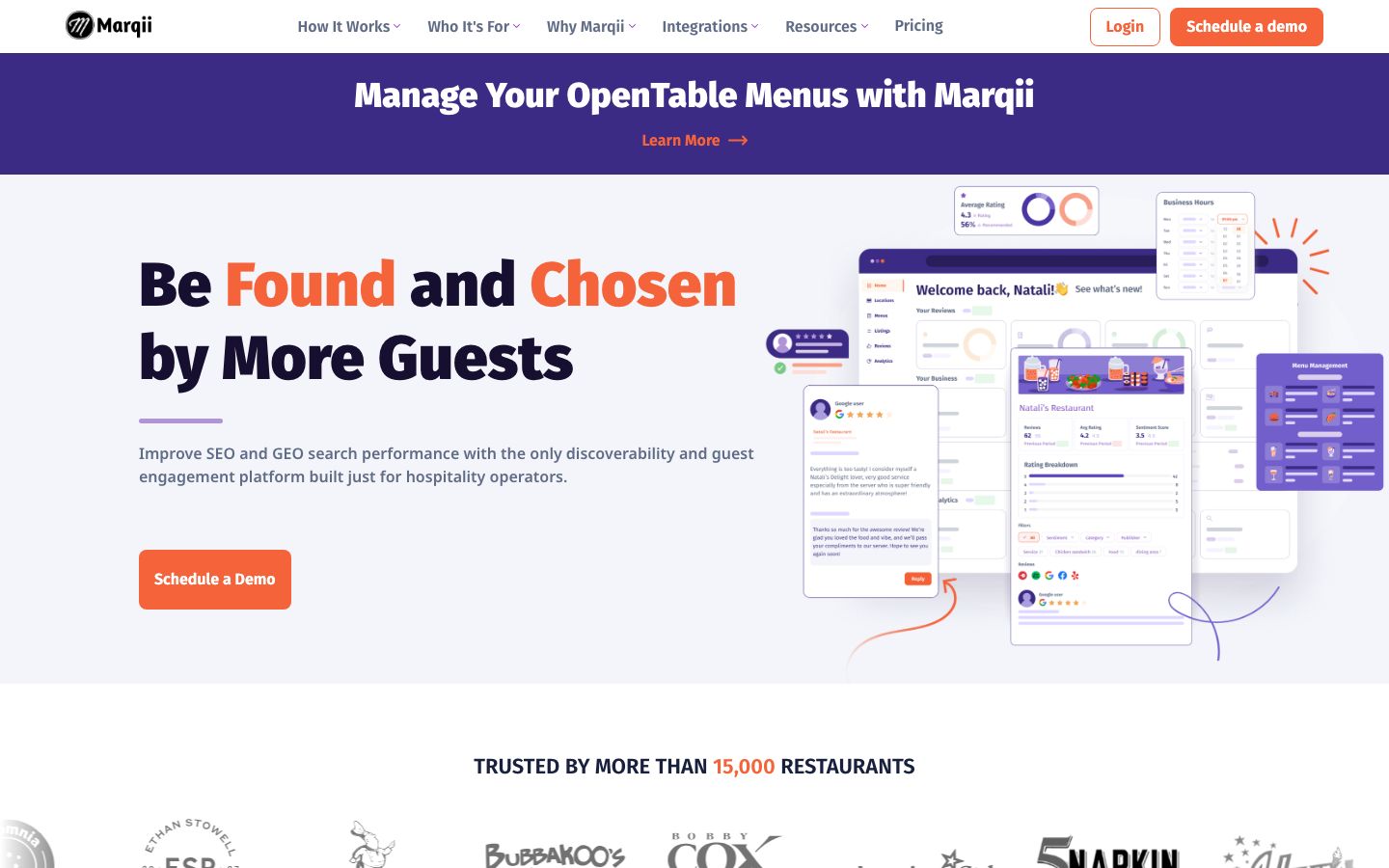
Marqii is restaurant software that customers first buy for menus and listings: hours and menus kept right on Google, Yelp and the other sites diners check, straight from the POS, with reviews in the same dashboard from the Growth plan up. It sells only to hospitality, and a third of its clients run 30 or more locations. It is built for the restaurant that changes its menu often and is tired of fixing it app by app.
Reviewflowz or Marqii?
On every Marqii plan below the $250 package, an AI draft sits until someone clicks Reply. In Reviewflowz the draft copies the tone of your outlet's earlier replies, and your rules send it to Google and Facebook without a click.
On the volume job, Marqii covers the sites restaurants are reviewed on: its feed holds Google, Yelp, Facebook, OpenTable, Tripadvisor and the delivery apps, and replies go out on Google, Yelp and Facebook without leaving it. Sentiment comes in four fixed categories plus your keywords. A review that thanks a server can carry a generic Staff Recognition label.
Marqii publishes its prices per location, all on yearly contracts. Listings and menus alone cost $90 on Base, and reviews arrive with Growth at $145. Scale at $180 adds AI-suggested replies. SMS for review requests comes as a separate monthly bundle, and each renewal can add up to 5% to the fees.
#3 OpenTable Reputation Management
- Best for: Full-service restaurants that already take their bookings on OpenTable and want reviews handled in the same software.
- Pros:
- Answers Google, Facebook and OpenTable reviews from the OpenTable dashboard.
- Sentiment in food, service and value, with keyword search across reviews.
- Alerts on negative feedback and automated review reports.
- Cons:
- Its page names Google and Facebook as the outside sources, not Yelp or Tripadvisor.
- Only for restaurants that book on OpenTable.
OpenTable, the reservation system behind more than 70,000 restaurants, bars and wineries worldwide, sells its own reputation management. A restaurant that already books there sees its reviews next to the reservations: the module gathers OpenTable reviews, brings Google and Facebook in beside them and lets the team answer all three from one place. Farmers Restaurant Group in Washington, D.C. is the customer its page quotes.
For the volume job it covers the basics: AI-assisted drafts that OpenTable says take half the time, review summaries, keyword search, sentiment in food, service and value, and alerts when negative feedback lands. Post-dining surveys go out from the same tool, so private feedback sits next to the public reviews.
It comes with OpenTable's plans, and the product page sends you to those plans or to sales rather than showing a price of its own. For a restaurant that books on another system, or a group split between OpenTable and something else, it is not an option.
#4 Bloom Intelligence
- Best for: Restaurants that want guest Wi-Fi sign-ins turned into a guest list for win-back offers, with reviews answered from the same platform.
- Pros:
- Guest Wi-Fi, the POS and reviews build one profile per guest.
- AI replies on Google, Yelp, Facebook, Tripadvisor, OpenTable and Tock.
- Reviews sorted by food quality, service speed, cleanliness, staff and ambiance.
- Cons:
- Review replies come only with Enterprise+, $220 a location a month billed yearly.
- Every plan is on a contract; cancelling any time applies to the first 90 days.
Bloom Intelligence is a marketing platform for restaurants built on guest data. The guest Wi-Fi, the POS and the reviews feed one profile per guest, and email and text campaigns bring lapsed guests back. It counts more than 1,000 restaurants as customers, with Corky's Kitchen & Bakery and Roka Akor among the names on its site, and its review module answers with that guest data behind it.
On the volume job, Bloom answers reviews on six sites, OpenTable and Tock included, and lets you choose by star rating which replies publish on their own and which wait in an approval queue. Its voice settings learn from what guests write and from the tone you set. Every review is sorted by topic, with staff as one of the topics.
Plans are priced per location: $105 for the customer data platform and $160 for the marketing plan, both billed yearly. Reputation management sits only in Enterprise+, at $220 a location billed yearly. Bigger groups pay as little as $70 a location, and every plan is a contract you can cancel during its first 90 days.
Try it on last weekend's reviews
Connect your outlets' Google, Yelp and Tripadvisor listings and read the replies Reviewflowz drafts for the reviews you have not answered yet.
#5 Ovation
- Best for: Quick-service and fast-casual brands that want a two-question text survey after every order and a quick way to win back unhappy guests.
- Pros:
- Texts a two-question survey after each order placed through Toast, Square or online ordering.
- Sorts feedback and reviews into 35+ restaurant categories, like speed of service.
- Replies post to Google and Yelp from Ovation's dashboard.
- Cons:
- Its automatic responses answer survey feedback only; Google and Yelp reviews wait for a click.
- Quote only; renews yearly unless cancelled in writing 60 days ahead.
- G2: 4.0 out of 5 (1 review)
- Capterra: 4.9 out of 5 (19 reviews)
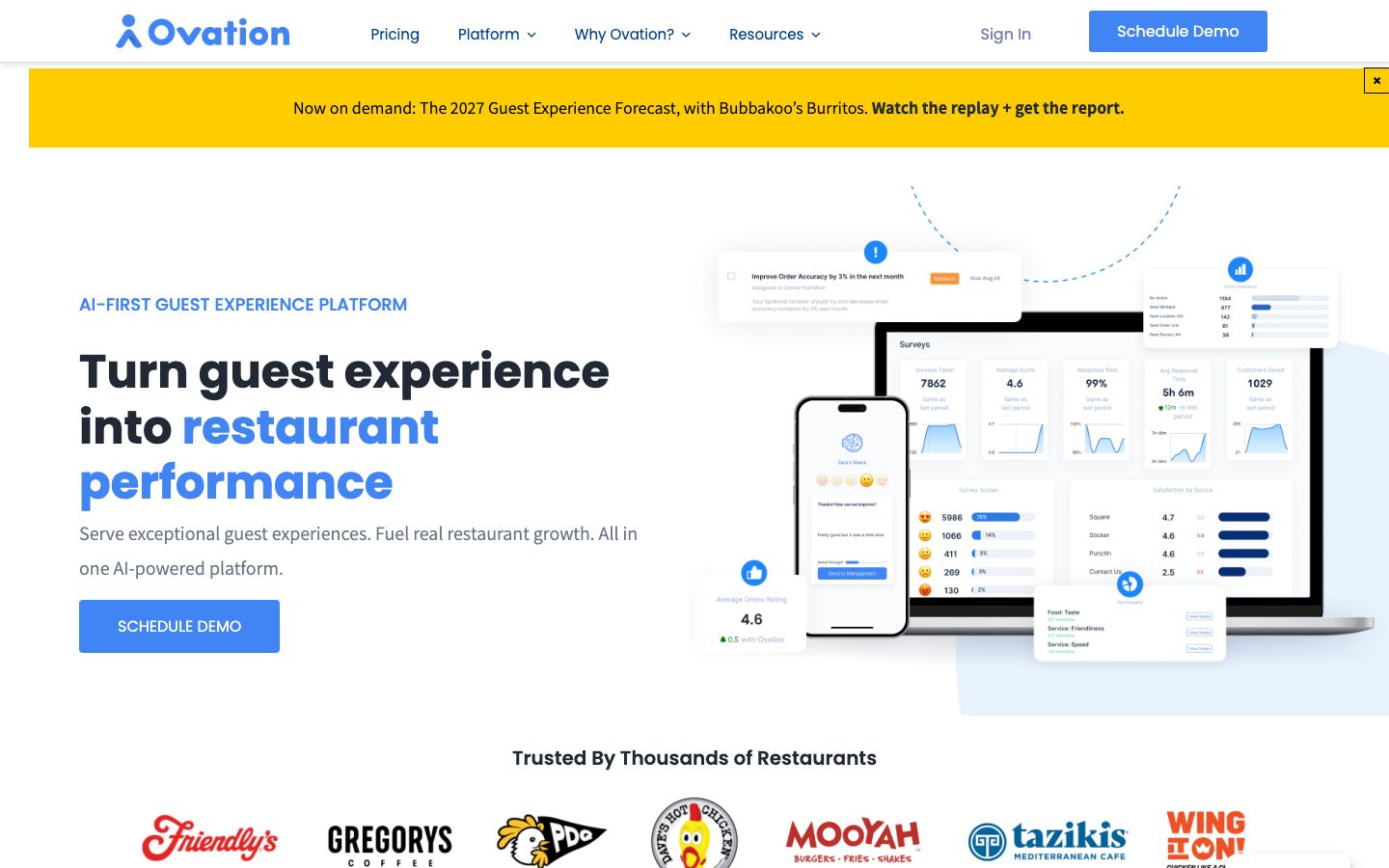
Ovation is guest feedback software built for multi-unit restaurants. What its customers value most is one thing: a two-question text that reaches the guest right after the order, catches the unhappy ones in private and points the happy ones to Google or Yelp. It connects to more than 50 POS, online ordering and loyalty systems, and it is listed in Toast's partner directory.
Reviewflowz or Ovation?
Ovation writes a Google or Yelp reply once someone presses its AI button. Reviewflowz sends Google and Facebook replies out under your rules, in the voice of that outlet's past replies, and leaves a ready draft on every other review.
For a restaurant whose problem is volume, Ovation's strength comes before the review: the survey and the recovery. Its review side gathers Google, Facebook and Yelp in one feed, and drafts replies in one brand voice set for the whole company. Its 35+ categories are written for restaurants, from food freshness to speed of service.
Ovation quotes every account, and WebstaurantStore members are offered Ovation Base at $119 a month. Each contract rolls over yearly, and leaving means writing to your customer success manager and the cancellation inbox at least 60 days before the term ends.
#6 Momos
- Best for: Restaurant brands that want guest surveys, loyalty offers and reviews in one inbox, with an AI agent answering guests.
- Pros:
- Replies post to Google, Facebook, Yelp, OpenTable and DoorDash.
- AI drafts follow your past replies and come in the guest's language.
- Reviews, surveys and delivery-app feedback land in one unified inbox.
- Cons:
- Quote only; the order form is non-cancellable and renews 7% higher each year.
- A first Google connection brings back only the past 90 days.

Momos is software for restaurant and food brands only. Reviews, surveys and delivery-app feedback share one inbox, an AI review manager sits on top, and loyalty, offers and a guest data platform sit beside it. Its case studies are chains: Potbelly runs guest feedback and recovery for 472 locations in it, and Just Salad uses its AI replies.
Reviewflowz or Momos?
When you first connect Google, Momos brings back the last 90 days, and it has no export of lifetime reviews. A connected Google profile in Reviewflowz arrives with its whole history and every review exports, so head office can set an outlet against the same month last year.
On answering at volume Momos is strong. Rules by rating and site decide which replies post on their own, the drafts learn from your past replies and arrive in the guest's language, and replies go straight to OpenTable and DoorDash as well as Google and Yelp. Sentiment and AI tags sort every review. Staff ratings come from guests picking a staff member inside a Momos survey.
Prices are quoted after a demo, and a third-party estimate puts chains at about $149 a location a month. The AI agent Alfie and Alfie Assist cost extra, and stopping the yearly renewal takes written notice 30 days before the term ends.
#7 Tattle
- Best for: Delivery-heavy restaurant brands that want DoorDash, Uber Eats and Grubhub reviews answered beside a survey after every order.
- Pros:
- Answers DoorDash, Uber Eats and Grubhub reviews from the same dashboard.
- Surveys go out by text or email after each transaction, from Toast or Square.
- AI sorts reviews by food quality and speed of service, with menu-item feedback.
- Cons:
- Review replies need the Reputation Management add-on; delivery reviews are another add-on.
- A person on your team sends every reply; nothing posts automatically.
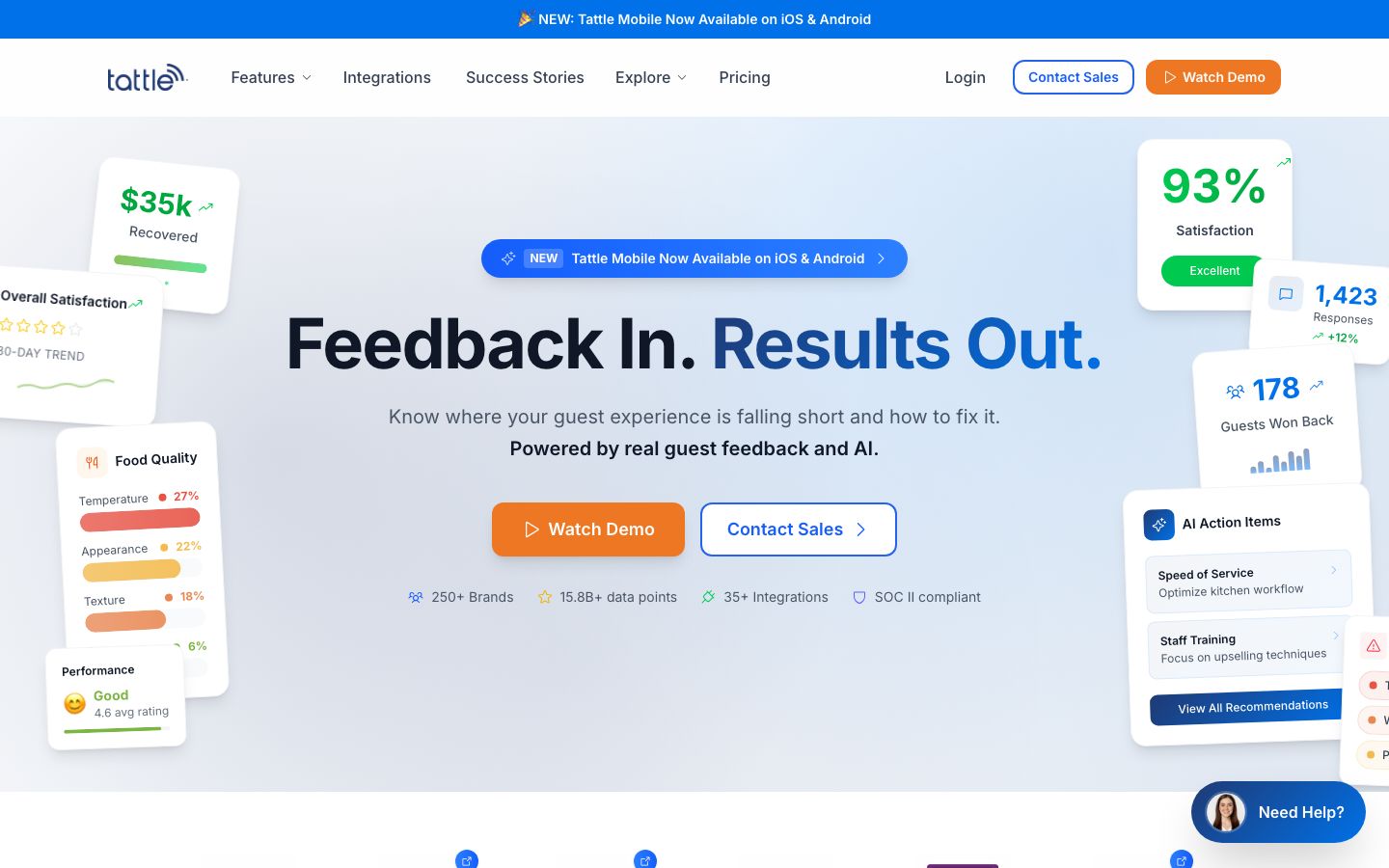
Tattle is what restaurant brands use in place of mystery shops. A short survey reaches the guest by text or email after each order, on every sales channel, and its AI Coach turns the answers into a plan for each franchisee and general manager. Its case studies run from 5 to 596 locations, and Tattle itself does not recommend its product to brands with fewer than 10.
Reviewflowz or Tattle?
Tattle leaves every reply to someone on your team, who generates it, reads it and sends it, in one voice shared by all stores. Reviewflowz lets your rules post each store's Google and Facebook replies, drafted in the words that store's managers have used before.
Its review module covers the delivery apps too. DoorDash, Uber Eats and Grubhub reviews come into the dashboard with Google, Yelp and Facebook, and the team answers them there. Feedback requests go out 90 minutes after a transaction through its integrations, with up to three reminders.
Tattle quotes every brand, and an archived price page showed $125 a unit with a five-unit minimum. Subscriptions renew on their own and end at the close of the paid term once you contact Tattle.
#8 SevenRooms reputation management
- Best for: Restaurants that already run their reservations and guest profiles on SevenRooms and want reviews beside each guest's visits.
- Pros:
- Google, Yelp and Tripadvisor reviews in one dashboard, answered in line.
- Each review connects to the guest profile the reservation already built.
- Surveys go out after on-premise and off-premise experiences.
- Cons:
- Only for venues on SevenRooms, priced with its platform rather than on its own.
SevenRooms, the reservation and guest CRM platform used by more than 15,000 restaurants, sells a reputation management module inside it. Reviews from Google, Yelp and Tripadvisor land in the same dashboard as the bookings, each one can be answered in line, and the review sits on the guest's profile.
For the volume job it does the basics: one place for the three main open sites, in-line replies, tags set by star rating and a daily summary of reviews, which the team at Long Meadow Ranch singles out on the page. Surveys after a meal, an order or an event invite happy guests on to Google, Yelp or Tripadvisor.
It is sold with the SevenRooms platform, so it only makes sense for a restaurant that books there, and the price comes with that platform rather than on the module's page.
#9 Birdeye
- Best for: Restaurant groups that want texting, listings, social posts, surveys and reviews bought from one vendor under one contract.
- Pros:
- On Toast, it asks guests for reviews, referrals and survey answers and keeps menus synced.
- Listings, messaging, social, surveys and reviews in one suite of 21 products.
- Replies post to Google, Facebook and Yelp from Birdeye.
- Cons:
- The term can't be cancelled, and ending renewal needs notice 90 days ahead.
- 55 of 160 negative reviews over two years are about the contract or cancelling.
- G2: 4.7 out of 5 (4,327 reviews)
- Capterra: 4.7 out of 5 (712 reviews)
- Trustpilot: 3.5 out of 5 (688 reviews)
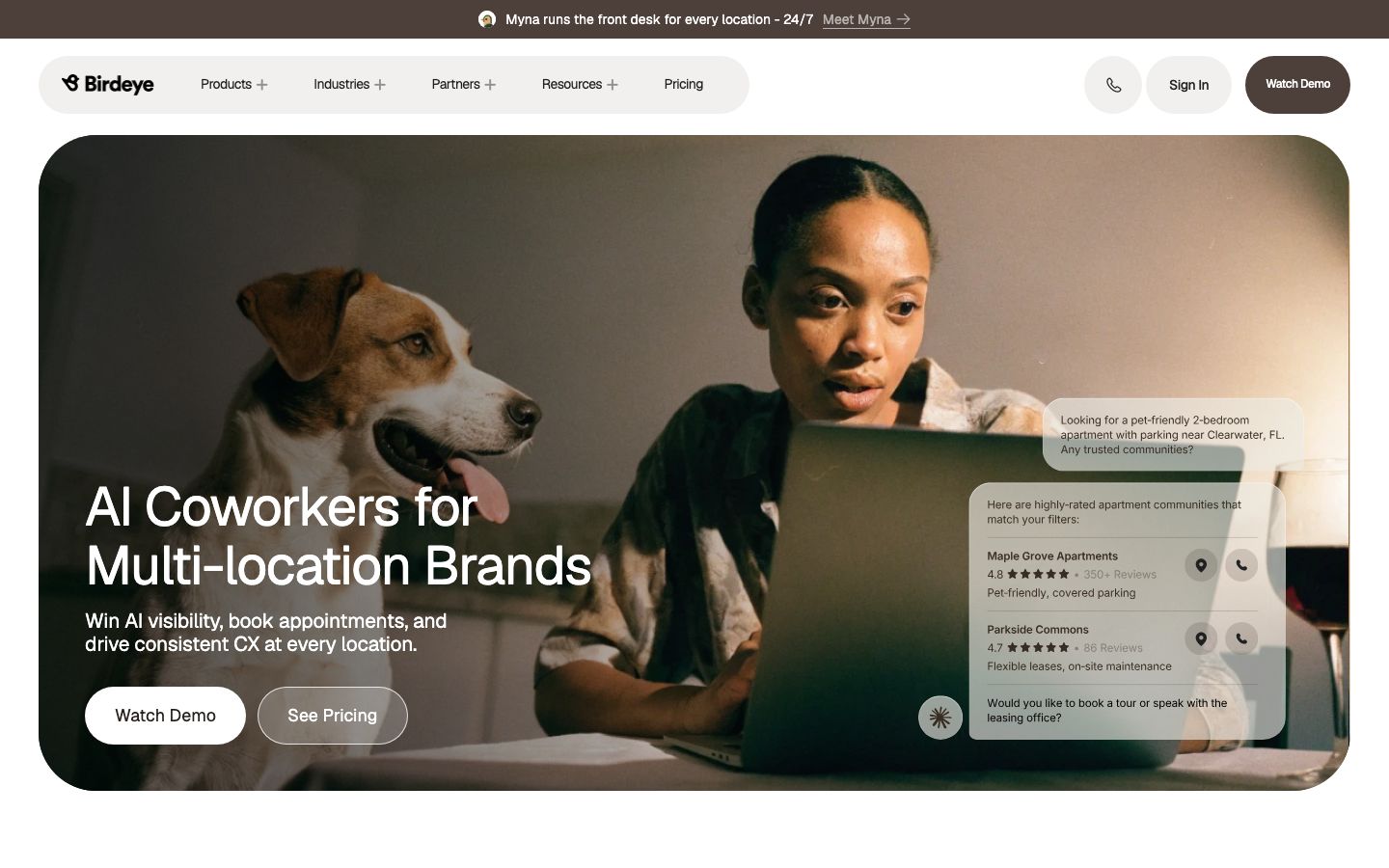
Birdeye sells review management as one part of a suite: listings, messaging, social posts, surveys, payments and AI agents, bought through sales. Its restaurant page promises to win guests at every location, and Toast's partner directory lists it for asking guests for reviews, referrals and survey answers, with location and menu details pushed to Google, Yelp and Instagram.
Reviewflowz or Birdeye?
Next to reviews, Birdeye sells 21 other products, and its AI replies follow a voice and tone you set by hand. Reviewflowz sells reviews alone, and each reply it drafts continues the ones your managers have posted over the years.
Ease of use comes up in 315 of the 572 positive reviews its users left over two years. For a restaurant the reply side is complete: AI agents answer reviews, Yelp included, under approval rules you set, and a tagging agent sorts them by theme.
Birdeye quotes every account, and a third-party source puts the entry at $299 a location a month. Contracts renew on their own and cannot be cancelled during the term, and each renewal adds an 8% fee on top of the recurring price.
#10 ReviewTrackers
- Best for: Restaurant brands that want listings and local rank tracking next to a review dashboard, at a published entry price.
- Pros:
- Hwy 55, a burger chain, answers reviews 75 percent faster in its case study.
- An entry plan at $89 a location a month, billed yearly.
- Topic sentiment and competitor benchmarks on the Essential plan.
- Cons:
- Non-cancellable for the term; renews unless cancelled 30 days ahead.
- Replies post on Google and Facebook, not Yelp; SMS credits cost extra.
- G2: 4.6 out of 5 (161 reviews)
- Capterra: 4.7 out of 5 (172 reviews)
- Trustpilot: 3.7 out of 5 (1 review)

ReviewTrackers, now part of Qualtrics through Press Ganey Forsta, watches reviews for brands across a long list of sites, with requests, AI replies, listings and local rank tracking sold on annual per-location contracts. Its restaurant story is Hwy 55 Burgers, Shakes, and Fries, a diner chain that answered its reviews 75 percent faster.
Reviewflowz or ReviewTrackers?
ReviewTrackers picks the reviews it answers alone by star rating and location group, and its AI works from a prompt you type. Reviewflowz also sorts by site and keyword, and learns its wording from your managers' own past replies.
For a restaurant the feed is wide, with Yelp and Tripadvisor beside Google, and topic sentiment arrives on the Essential plan. Its replies post from the tool on nine sites, Google and Facebook among them, and Yelp is not one of the nine.
The entry plan is $89 a location a month, billed yearly, and SMS credits and the API cost extra. Contracts renew unless cancelled 30 days ahead, and the fees for the rest of the term stay due.