
Why Google deletes your reviews, and what you can do about it
 By Axel

Google removes about 2% of new reviews in their first week, and about 1.4% of the reviews already on a profile every year. It removes one-star reviews more than five-star ones, it never tells you which review went, and it will not give most of them back. That is not the bug people search for. The bugs of 2025 and 2026 were real, Google fixed them, and the reviews came back. The rest is a filter that runs every day on every profile, and the way to live with it is to understand what it looks at, keep your own copy of your reviews, and treat the losses as the price of collecting reviews at scale.
This is what we learned from tracking 4.9 million reviews on 9,048 Google profiles every day for two weeks, from Google's own help pages, and from the people who deal with this for a living.
Two different things make reviews disappear
The bugs. In February 2025, Google removed a wave of reviews it suspected were fake or AI-written. The removals hit five-star reviews hard, legitimate ones included, and the counts dropped within hours. The same thing happened in October and November 2025. Then in February 2026 came something stranger: reviews vanished from the list on the business profile but stayed in the count, and stayed visible on the reviewer's own profile. Google's Victoria Kroll acknowledged a display issue on February 10 and called it mostly fixed on February 13, while agencies and API users kept reporting new gaps through February 16 and into March. By March 16 it was over and most reviews were back.
The filter. Underneath those incidents, Google removes reviews every single day, on purpose, and has done for years. Over two weeks in August 2026 we watched 4,590 reviews disappear from 9,048 profiles, with no incident running. That is the part this article is about.
How to tell which one you have:
- The count on your profile is higher than the number of reviews you can scroll through, or the reviews still show on the reviewer's profile: a display problem. Wait, and keep a record.
- The count dropped and the review is gone from the reviewer's profile too: a removal. It will not come back on its own.
- A customer says they posted and nothing appears: a review stuck in the check Google runs before publishing, which can take a few days, or a review that failed it.
How Google's review filter works
Every review goes through a check before it is published. Google says this takes a few days at most. Then the real screening starts, and it follows the age of the review.
In our data, a new review is on probation for seven days. Negative reviews are screened first, on days 2 and 3. Positive reviews are screened on days 6 and 7: that is when 47% of the positive reviews that go in their first 13 days are removed. After day 8 the daily risk falls to about a tenth of the day-7 peak and stays there. The peak follows the review's age whatever the weekday it was posted, so this is an age trigger, not a weekly clean-up.

Google describes what the models look at in its transparency report: the account, including its links to other suspicious accounts and paid review operations, and the place, including "a sudden influx of 1 or 5-star reviews". Reviews that users flag can go to a team of human reviewers. In 2025, Google says it blocked or removed over 292 million reviews while publishing more than a billion, and put posting restrictions on 782,000 accounts.
Old reviews are not safe either. Half of the deletions we saw hit reviews under a month old, but a third hit reviews over a year old. Most of those go when Google removes the author's whole account: one deletion in five, where we could trace the author, was every review by that account disappearing on the same day, across businesses that have nothing to do with each other.
What it removes, and what it ignores
The pattern is clear once you compare reviews of the same business at the same age, which is how every figure below was measured.
The account matters more than the text. A first review is deleted 5.6 times more often than a review from a Local Guide of level 6 or more. Accounts writing their first review produce 14% of reviews and 22% of deletions. An experienced reviewer's words are the same words; Google trusts the account, not the sentence.
Google removes the extremes, and one-star first. 5.7% of new one-star reviews are gone within a week, against 1.8% of five-star and under 1% of three- and four-star reviews. Inside the same business, a one-star review is deleted 3.9 times more often than a four-star one. A five-star is deleted 1.15 times as often, within the margin of error: four and five stars are equally safe.
The day matters, the month does not. A review posted on a day the business gets at least three positive reviews and four times its usual daily count is deleted 1.8 times more often. The risk climbs with the count on the day: 1.15% for a lone review, 3.1% for five to nine. A month with triple the usual volume is not riskier at all. Google reacts to the burst, not the trend.
Too perfect reads as fake. Profiles with 85% or more five-star reviews lose 2.2 times more reviews than profiles at 50 to 70%, at equal sector, size and volume. On a profile rated 4.8 or more, even a four-star review is deleted nine times more often than on a profile under 4.5.
What makes no difference. Reviews that name a staff member are deleted at exactly the same rate as reviews that do not (1.01x). Google's policy has banned asking staff to solicit reviews that identify them since April 2026, and does not enforce it. Length makes no difference. "Highly recommend" and similar phrases make no difference. Photos look protective in the raw numbers and the effect disappears with controls. Replying to every review does not protect a profile as such: the reply on the review counts, the habit does not (more on this below).
The good news: negatives go too
The filter is not aimed at you. One- and two-star reviews are 9% of all reviews and 20% of deletions. In the US, 6.3% of new negative reviews are gone within a week.
It cleans up review bombs on its own. Two Spanish gyms in our panel received 297 one-star reviews on August 1 and 2; 295 were gone by August 16. A German bus tour operator with 156 reviews lost 46 one-star reviews, posted between 2018 and 2026, in four days. Old negatives can go all at once.
In Germany, Google now shows a notice on the profile counting reviews removed after defamation complaints in the past year, reversed appeals excluded. The same mechanism that costs you a five-star review is the one that removed a competitor's fake one-star.
If a review bomb lands on your profile, the first move is to wait a week and watch. The second is to report what is left, which Reviews you want gone covers.
Accept the tax
Google is going to remove some of your reviews no matter what you do. The only businesses that never lose one are the businesses that never get one. In our panel, 4% of businesses collecting under two reviews a month lost a review in two weeks, against 67% of businesses collecting 50 or more. Deletions across the panel added up to a tenth of what was published over the same period. If you collect at scale, you pay.
In some industries the rate is high. Home services lose 3.9% of new positive reviews in their first week, healthcare 2.6%, restaurants 0.85%, hotels 0.75%. US profiles lose twice as much as European ones. Four US pest-control chains lost 1,199 positive reviews across 102 locations in two weeks, 26% of everything we saw go, and those chains were doing nothing a hotel does not do except collecting many times more reviews. A business hit in week one had a 33% chance of being hit again in week two.
None of this moved anyone's rating. Among the businesses that lost five or more reviews, the average rating moved by 0.01 star, because Google removes more one-stars than five-stars and the two cancel out.
So judge the campaign, not the loss. Businesses whose reviews mostly name a staff member lose 13 reviews for every 100 they gain, against 8 for the others, and still end the year with twice the net reviews because they collect 2.7 times more. Count what is still online on day 8, compare it with what you had, and move on. A deletion means the machine is running on your profile, and it runs hardest on the profiles that are getting reviews.
What you can do before: keep reviews on the profile
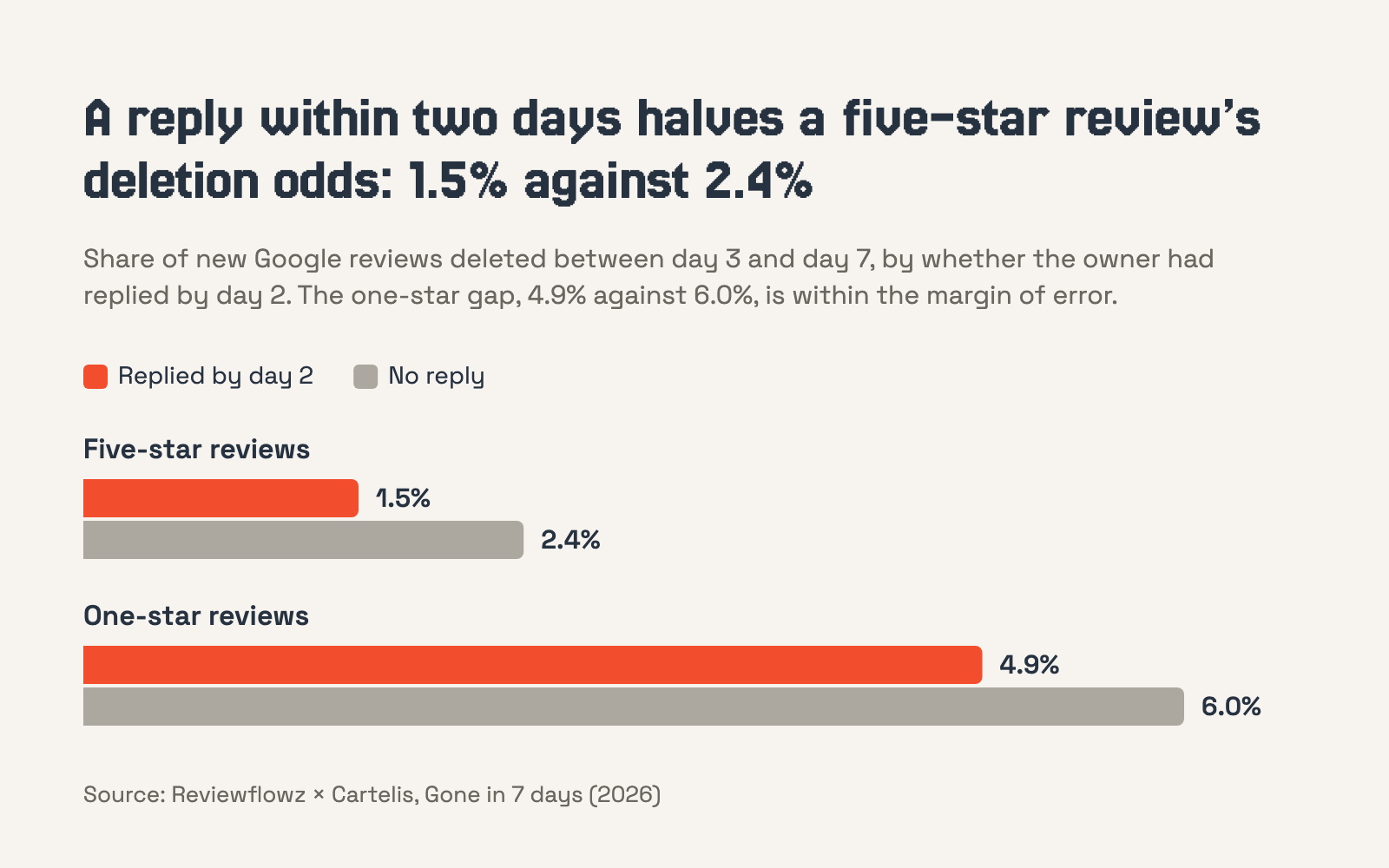
Reply to every positive review within two days. Among new five-star reviews, 1.5% of those with an owner reply by day 2 were deleted between day 3 and day 7, against 2.4% without one. At equal sector and size the odds are halved. Same day, next day or day 2 makes no difference, so there is no race, but the reply has to be there before the day 6 pass. It does nothing for one-star reviews.
Never let a campaign land on one day. Send requests when something happens for one customer, a sale, a job closed, a checkout, not to the whole list on a Monday. A busy month is fine. A busy day is 1.8 times the risk.
Ask customers who already review on Google. A first review is the most fragile thing on your profile. If a customer does not have a Google account, point them to Yelp or Tripadvisor instead of asking them to create one.
Do not gate, incentivise or push on the premises. Google's policy bans payment or discounts for a review, asking only happy customers, requiring a review while the customer is in the store, and giving staff a quota.
Let the mix breathe. A 4.9 built on 97% five-stars is a risk profile. Mixed ratings, replies and photos read as real. You do not need to chase four-star reviews; you need to stop filtering out everything that is not five.
Pace your review requests
Reviewflowz sends each request for one customer, after the event you pick, such as a closed job or a completed checkout, and after the delay you set. Quiet hours hold a request until your window opens. Requests follow your real customer flow instead of going out as one batch, so new reviews arrive across the week rather than in a burst.
How to handle a removed review
Google does not tell you that a review went, which one it was, or why. So handling a removal starts with knowing about it. Here is the routine, from spotting the removal to asking Google for the review back.
1. Find out which reviews went
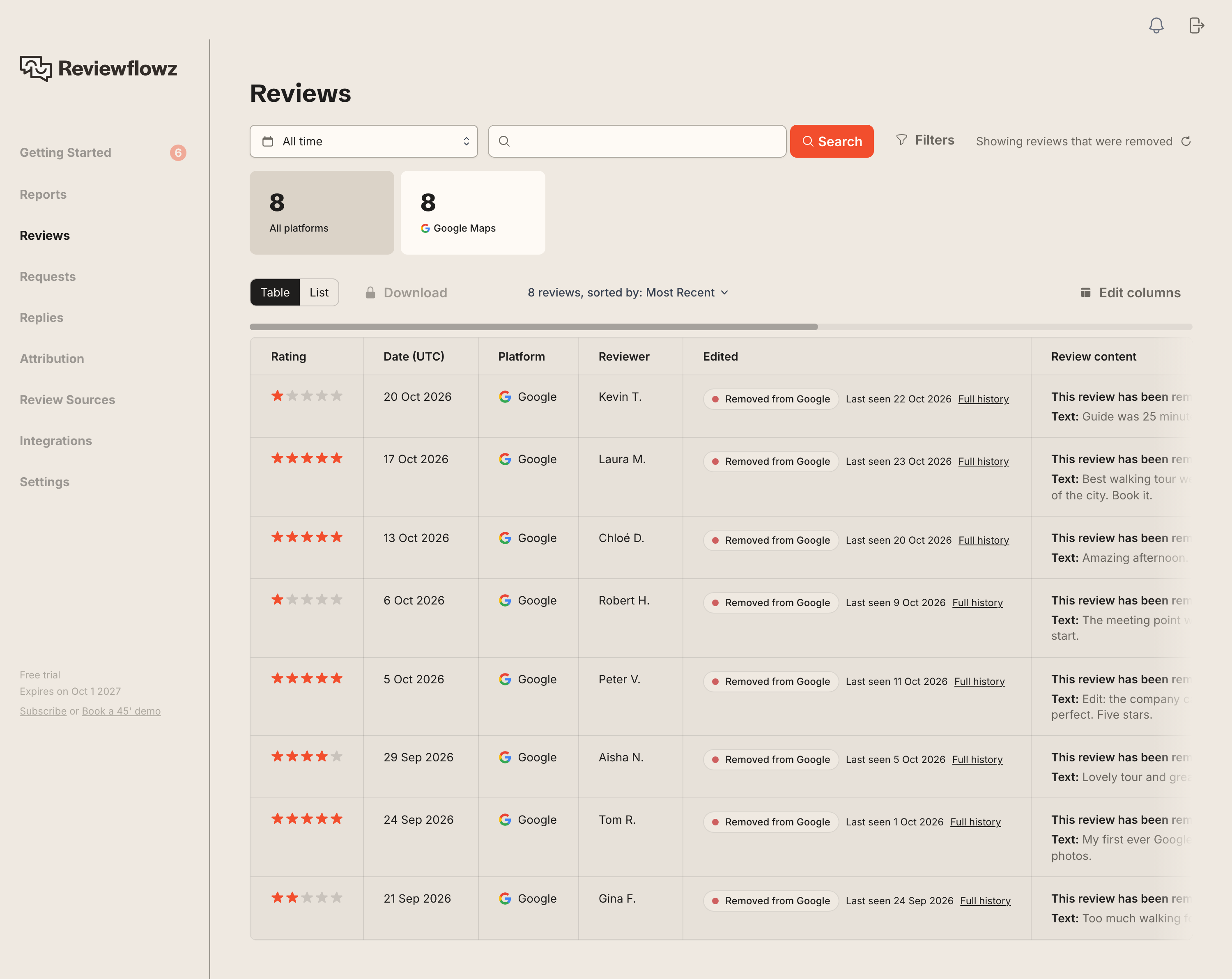
Your profile only shows what is live, so a removed review leaves no trace on it. You need your own copy of every review, taken before it disappears: an export once a month at the very least, or a tool that keeps watching the profile. To keep a dated record of every review, export the listing's reviews to CSV. Reviewflowz keeps every review it has seen on your Google profile and keeps checking the profile after the first import. When a review disappears, it is marked "Removed from Google" with the date it was last seen. Filter your reviews to Removed only and you get the full list, with the reviewer, the rating and the text Google no longer shows.
2. Read the full history of each one
A removal is rarely the only thing that happened to a review. Open Full history on any review and you see its whole life in order: the original version, every edit with the rating change, the day it was removed, and the day it came back if it did. That timeline answers the questions support will ask. It also shows what a screenshot of the live profile never can, such as a review that was edited from three stars to five a few days before Google took it down.

Reviews also come back. Google's bugs have restored reviews in batches, and a support request can bring one back too. When that happens the history records it, so you know which reviews are live again without checking the profile by hand.

3. Decide whether it is worth asking for
Ask for a review back when you are sure it is real: a customer you can name, a visit you can date, nothing in the text that breaks Google's rules. Google says its automated spam system may mistakenly remove legitimate reviews and to contact support when it does. That is the case support can fix. Do not ask for a review that broke a rule, including one you collected with an incentive or by asking only happy customers: Google's help page says reviews removed for policy violations won't be restored.
Check the rest of the history before you ask. An agency on the Local Search Forum asked support to restore one review and got twelve removed one-star spam reviews back along with it, because support restored everything on the profile that complied with policy. Your removed list tells you what else could return before you open the case.
4. Ask Google support to restore it
There is no restore button in your Business Profile. The request goes through Google's support team, and it takes about ten minutes when you have the details ready.
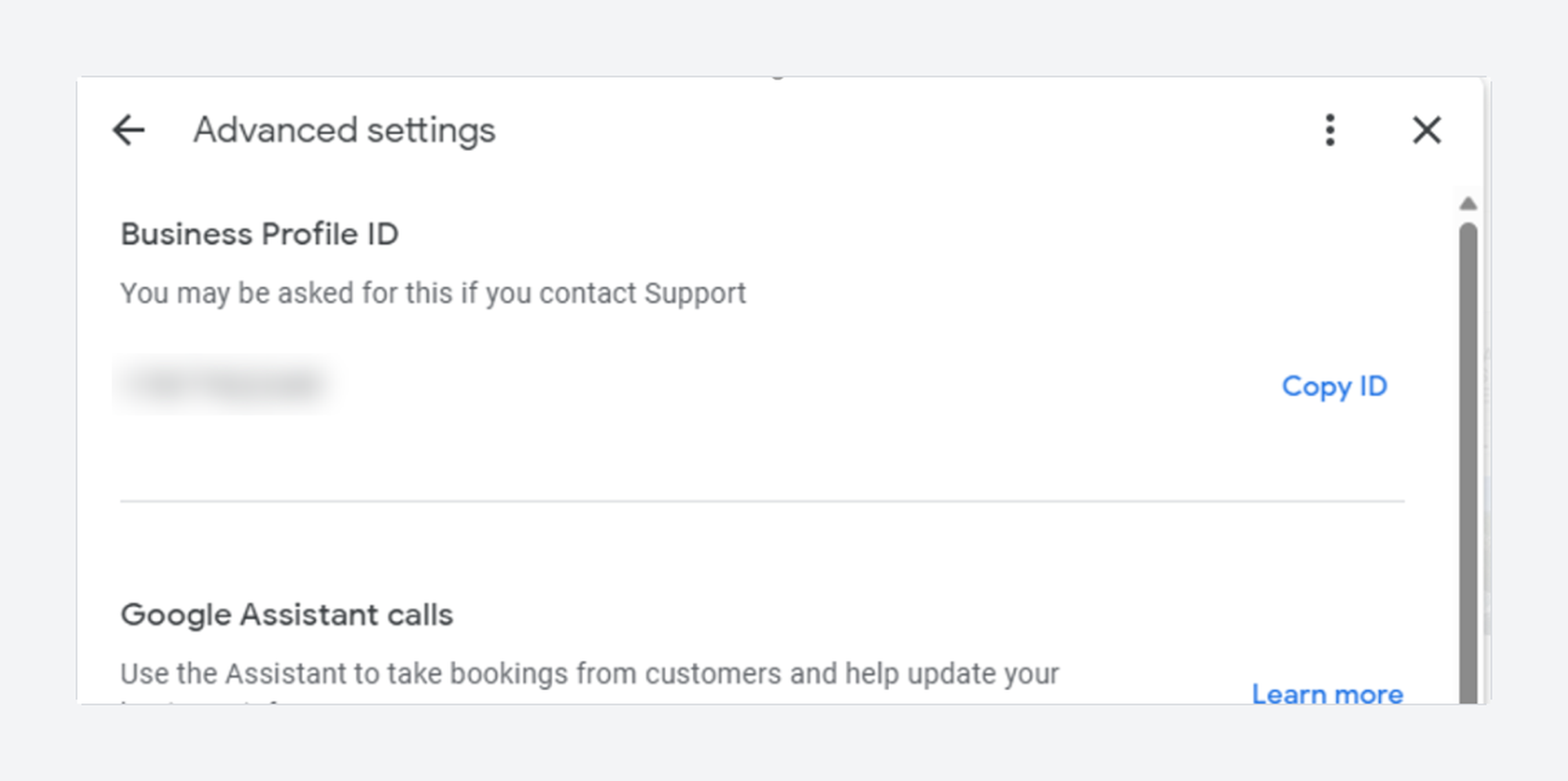
Get your Business Profile ID first. Open your profile on Google, click the three dots menu, then Business Profile settings, then Advanced settings. Copy the ID: support asks for it to find the right profile.
Open a missing review case.
- Go to Google Business Profile support, signed in with the Google account that owns or manages the profile.
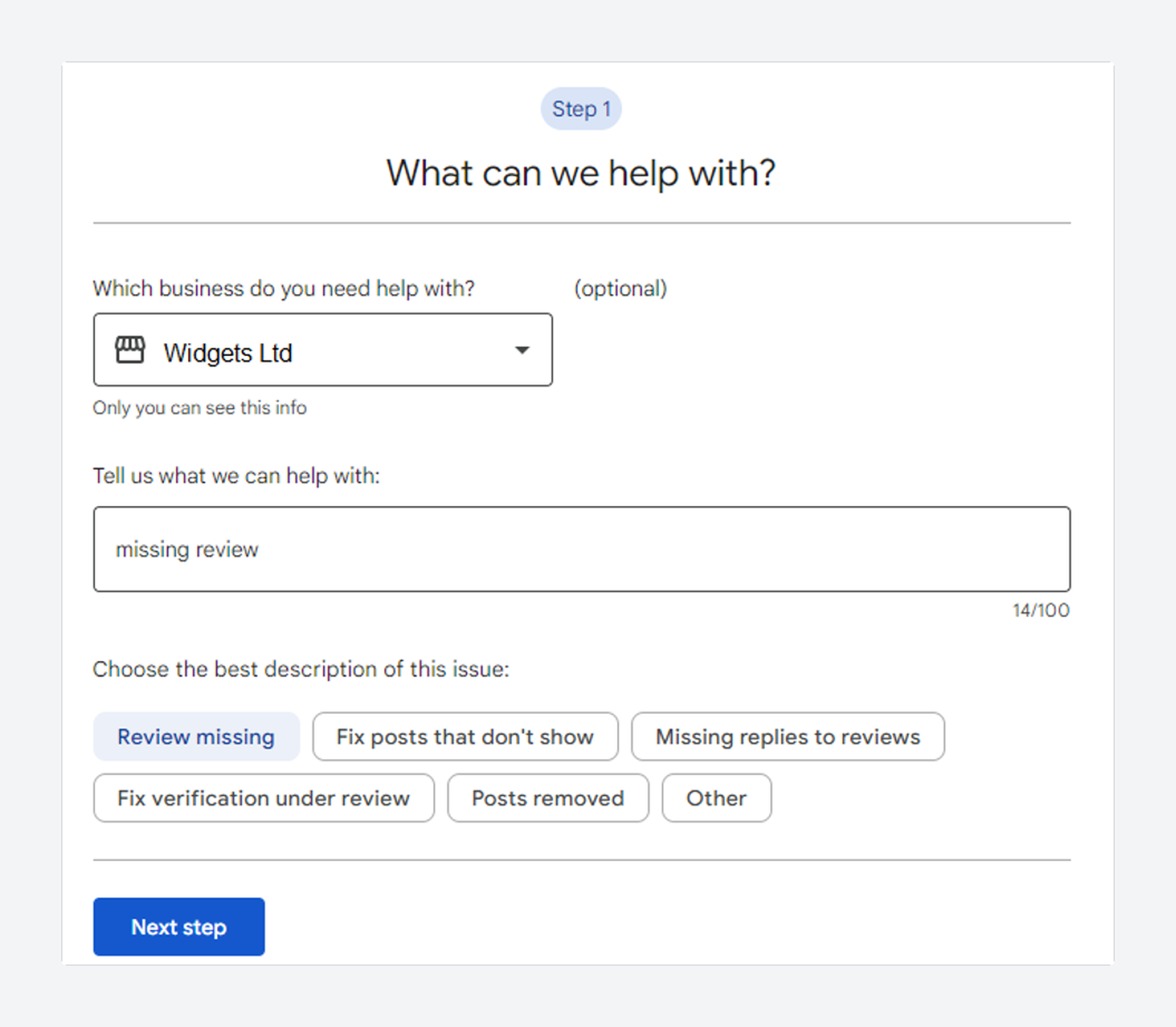
- Pick the business under "Which business do you need help with?".
- Type "missing review" in "Tell us what we can help with", choose Review missing, then Next step.
- Go past the suggested articles to the contact options and pick one. Email is the one Google offers most often.
- In the form, give the reviewer's name exactly as it appeared on Google, the rating, the date the review was posted and the date it disappeared, and paste the review text.
Attach your evidence. The strongest proof is the review as the reviewer still sees it. Ask the customer to open their own profile in Google Maps, go to the Reviews tab and send you a screenshot. If the review is listed there, it still exists and only your profile lost it, which is exactly what support can fix. Add its full history from your copy, so support sees when it was posted, edited and removed.

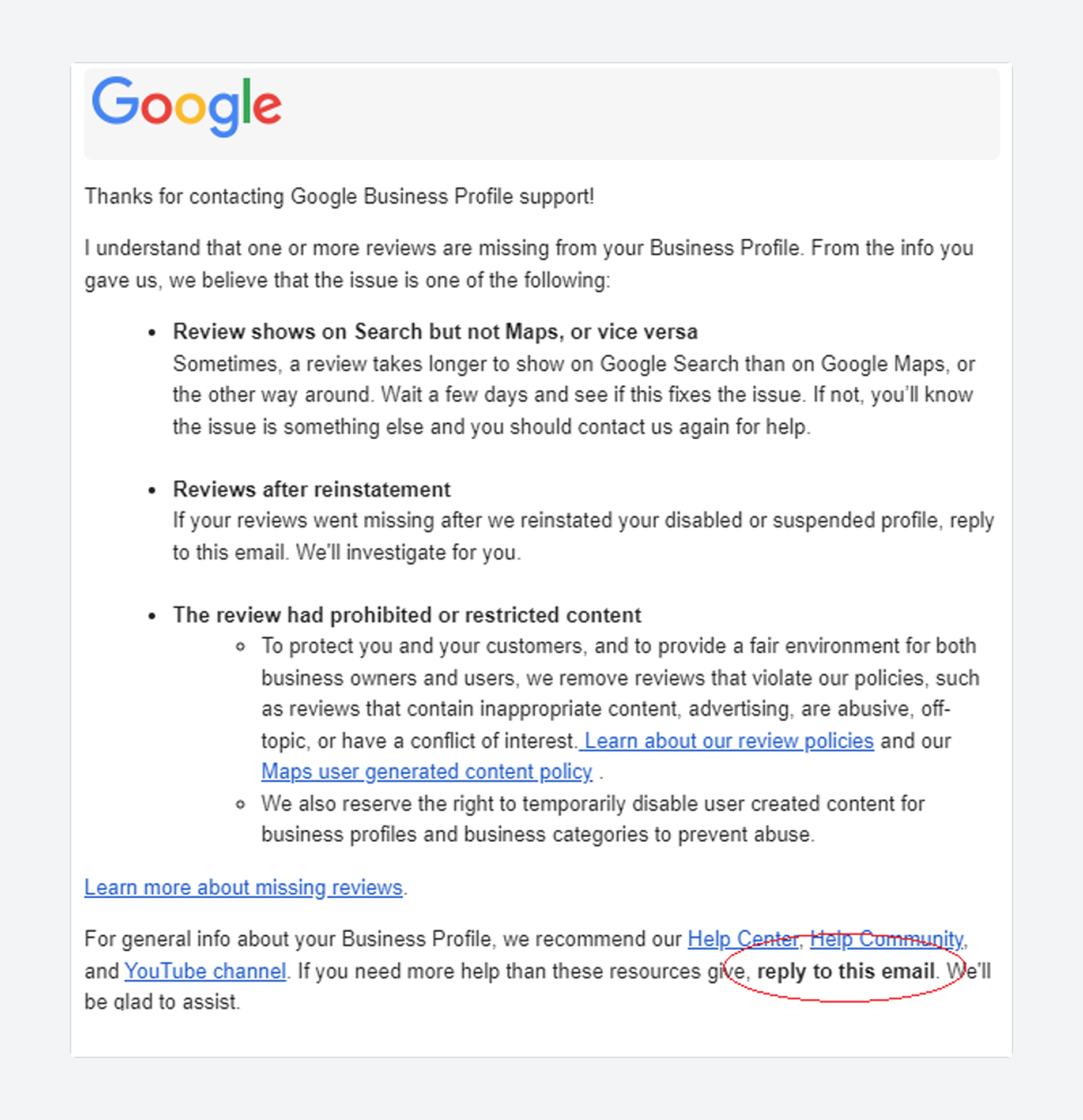
Reply to the first answer. Google's first reply is often an automatic email that lists the usual causes: a review that shows on Search but not on Maps, reviews lost after a suspension, or a policy removal. It is not a refusal. Reply to that email with your case and your evidence, and keep the case number, so every follow up lands on the same case.
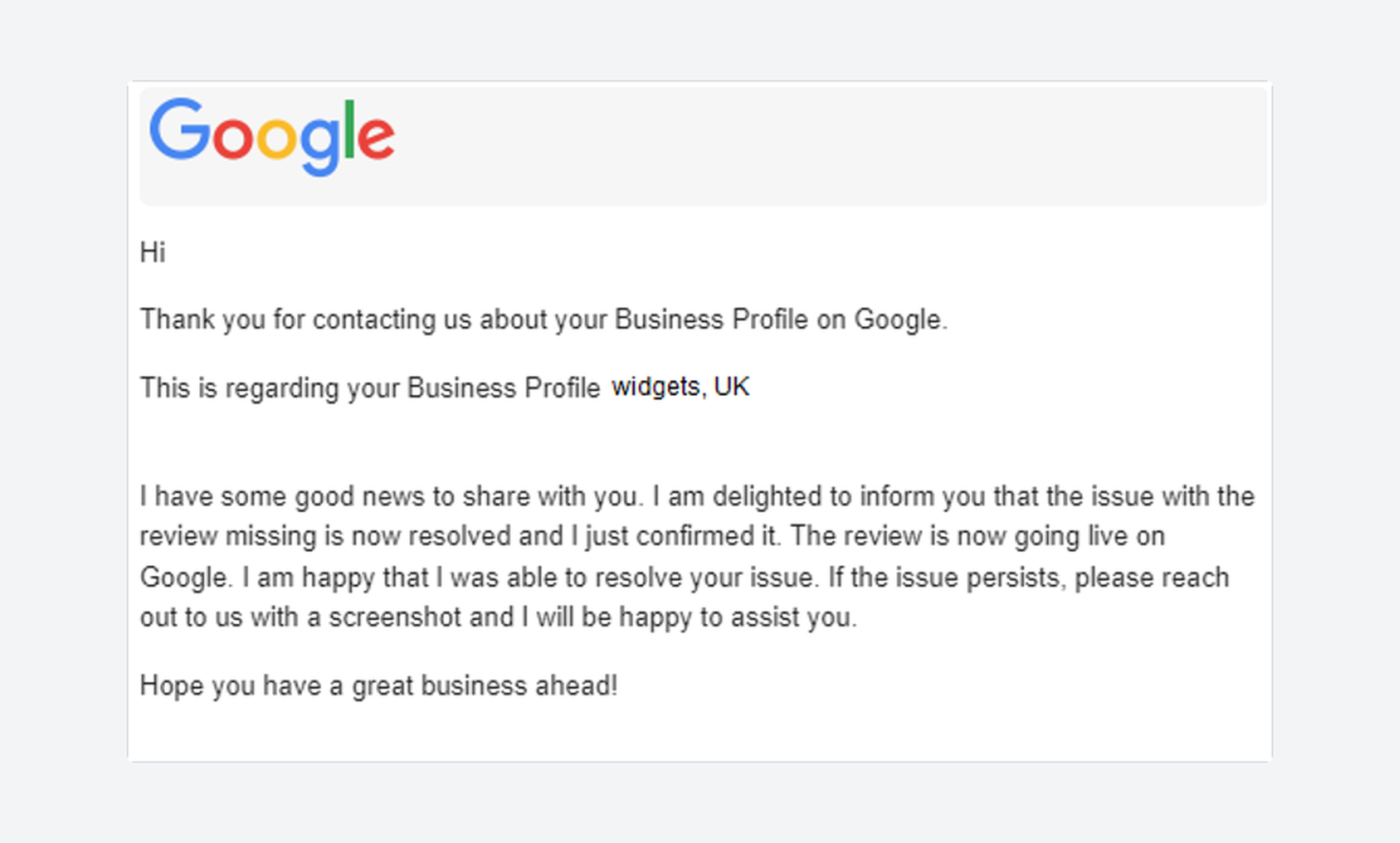
If support restores the review, Google emails you to say so, and the review shows up in its history as reinstated, with the date. If Google answers that it broke policy, it stays down, and the one thing left to do is keep collecting.
5. Know the next time it happens
Most removals land in a review's first week, so a monthly export finds them weeks late. Reviewflowz flags each removal as it is detected, and the removed review keeps its text, rating and dates. If the review was sent to your Slack, Microsoft Teams or Zendesk when it arrived, the removal is posted to the same thread, conversation or ticket. Removed review tracking is on the Pro and Premium plans, and every free trial includes it. Start a free trial, connect your Google profile, and from that day on no review leaves without you knowing.
Reviews you want gone: report and appeal
Report a review you want gone. On the profile, open the review, select Report, pick the reason, send. Or use Google's Reviews Management Tool, which lets you report and then check the status: "Decision pending", "Report reviewed, no policy violation", or "Escalated, check your email for updates". Google says evaluation takes several days. If the answer is no violation, you get one appeal, for up to ten reviews at a time, through the same tool. Reporting a review because you disagree with it goes nowhere: Google says it does not get involved in conflicts between businesses and customers. Report the ones that break a rule, pick the right rule, and attach proof. Google notes that merchants in the EEA can also report third-party reviews directly on Google.
When Google restricts the whole profile. If Google decides the profile itself violated the fake-engagement policy, it says it emails the owner first, then applies one or more of: no new reviews for a set period, existing reviews unpublished for a set period, a warning on the profile that fake reviews were removed. Customers see "Posting reviews is turned off for this place" or a banner about suspected fake reviews. In April 2026 Google also announced it would pause new reviews on a profile after a spike in spam, with a banner, as a protection rather than a punishment. You can appeal through the profile review form, and it is worth filing: the case gets logged, and that is what tells Google where it is wrong.
Does it hurt?
Not the rating. The cost is count and recency: reviewers and ranking systems both look at how many reviews you have and how recent the last ones are, and a removed review is a removed date. The cure is the same as the prevention: keep collecting, pace it, reply, and keep a copy.
The full method, every result with its margin of error, and the tests that came back empty are in the research page and the 28-page report. The numbers behind this article, next to everyone else's, are in 112 online review statistics.